
Every footwear brand lives or dies by the materials it puts on the shelf. The upper, lining, and performance layers decide how a shoe looks, feels, and holds up after weeks of wear. Yet many buyers spend their energy picking a factory and treat the material supplier as an afterthought. That gap is where quality problems, delayed launches, and failed compliance checks tend to appear. Sourcing the right shoe material partner takes the same discipline you would give to any other part of the supply chain.
To choose the right shoe material supplier, start by defining your product requirements, then screen candidates on production capacity, material range, certifications, sampling discipline, and communication before you commit to a bulk order. A supplier that fits your volume, meets your compliance baseline, and proves its quality through samples will protect both your margin and your brand reputation.
The steps below break the selection process into a practical sequence you can apply to your own shortlist.

Define Your Material Requirements Before You Search
Lock your design brief, target price, and expected order volume before you talk to a single supplier, because those three inputs decide which partners are even worth a conversation.
A supplier cannot quote fairly or recommend the right construction if it does not know what you are building. Buyers who skip this step end up comparing unrelated offers and chasing samples that never match the final product. Spend an hour on specification before you spend a month on sourcing.
Match the Right Shoe Material to Your Product
Footwear uses a short list of material families, and each behaves differently on the line and on the foot. The term “shoe material” covers leather, textiles, synthetics, and foam, while “shoe material” in finished goods usually means a layered build of upper, lining, and reinforcing components. A running shoe needs breathable, lightweight textiles and a stable knit, whereas a dress shoe leans on coated leather and structured backing. Write down the performance targets first, such as abrasion resistance, flexibility, water resistance, and weight, then map them to material families instead of letting a catalog pick for you. Our shoe lining material range is a practical starting point for the comfort layer.
Set a Quality and Compliance Baseline
Different markets enforce different chemical and safety rules, and your supplier must already work inside those limits. If you sell into the EU, restricted substance rules such as REACH apply to dyes and treatments, and a CE marking may be required for certain categories. US-bound goods face their own substance lists. Define the baseline up front so you can filter suppliers by what they can actually certify, not by what they promise verbally.
Where to Find Reliable Shoe Material Suppliers
Use several channels at once, including sourcing platforms, trade shows, and industry networks, because no single source shows you the full field, and cross-checking reduces the chance of a bad match.
Relying on one directory tends to surface the same crowded pool of traders. Spreading your search across platforms, events, and referrals gives you both volume and a way to verify claims against each other.
B2B Platforms and Supplier Directories
Large sourcing platforms list thousands of material and component suppliers with public trade records, response rates, and certification badges. Filter by years in business, export history, and verified documentation rather than price alone. Request the supplier’s own factory details and ask whether it is a manufacturer or a trading company, since that changes both pricing and accountability.
Trade Shows and Industry Associations
Footwear expos put material mills, laminators, and component makers in one place, and you can handle swatches and ask technical questions face to face. Industry associations publish member directories that often signal a baseline of standards adherence. The member directory maintained by the Footwear Distributors and Retailers of America, for instance, lists material and component suppliers alongside brands, which gives you a vetted roster to cross-check a new lead against. Walking a show floor also tells you which materials are trending, which helps you plan the next season instead of only filling the current one.
Referrals and Professional Networks
Designers, buyers, and fellow brand owners are a quiet but high-quality source of leads. A supplier that already serves a brand you respect has proven it can meet real production pressure. Ask specifically what went wrong as well as what went right, because the honest answer about problem resolution matters more than a clean reference.

Evaluate Production Capacity and Minimum Order Quantities
Match the supplier’s output and MOQ to your real volume, because a partner sized for mass production will frustrate a small brand, and a small workshop will bottleneck a growing one.
Capacity is not just a number on a brochure. It sets your lead time, your pricing ladder, and your ability to scale when a style takes off.
Understand MOQ and Lead Times
Minimum order quantities for shoe materials vary by substrate and by how much custom development the item needs. Standard woven or knitted textiles often start lower than coated or laminated constructions that require a dedicated run. Ask for the MOQ per color and per width, the sampling lead time, and the bulk production window, then pressure-test those dates against your launch plan with a buffer built in.
Assess Scalability for Growth
A good early partner should be able to grow with you. Ask what happens at three times your current volume: does it add lines, add shifts, or subcontract? Subcontracting is not automatically a problem, but it must be disclosed, because quality control gets harder the moment a second site enters the chain.
Check Material Range and Specialization
Favor suppliers with a broad, coherent material range, because covering upper, lining, and performance layers under one roof simplifies sourcing, sampling, and quality ownership.
A supplier that only sells one substrate will push your whole design toward that material. One with depth across categories gives you options and keeps accountability in a single relationship.
Upper, Lining, and Performance Materials
The upper carries the look and most of the wear; the lining touches the foot and drives comfort; and performance layers such as membranes handle water and breathability. Review each category with the same care. For a concrete example, our Oxford Fabric Upper shows how backing, coating, and weave combine to meet different performance targets. Lining choice affects odor, heat, and durability, so treat it as a specification, not a leftover.
Customization and Development Support
Beyond stock items, ask what the supplier can develop with you. Can it adjust denier, add a waterproof membrane, or build a multi-layer composite? Development support shortens your path from sketch to sample and keeps intellectual property inside one trusted relationship. Suppliers that run their own lab or laminating line usually turn revisions faster than those farming every step out.
Verify Quality Control and Certifications
Treat certifications and a documented inspection process as entry tickets, not bonuses, because they are the only objective proof that a supplier can meet your market’s rules and your defect targets.
Verbal assurance disappears the moment a shipment fails. Paper and process are what survive a dispute.
Key Certifications to Look For
A quality management system certified to ISO 9001 signals that the supplier runs repeatable processes rather than heroics. Chemical safety compliance, such as REACH, matters for EU access, and a CE marking may apply to specific product types. For footwear testing methods and material performance benchmarks, guidance from SATRA, the independent footwear technology center, is a useful reference point when setting your own spec. Ask for original certificates, not scans, and check the numbers against the issuing body where possible.
Sampling and Inspection Standards
Build inspection into three points: a pre-production sample you sign off on, in-line checks during the run, and a pre-shipment audit. Many buyers use an AQL 2.5 sampling plan for general goods and tighten it for premium lines. Define acceptable defect rates in the contract and confirm who pays for third-party inspection. A supplier that welcomes unannounced checks is usually one worth keeping.
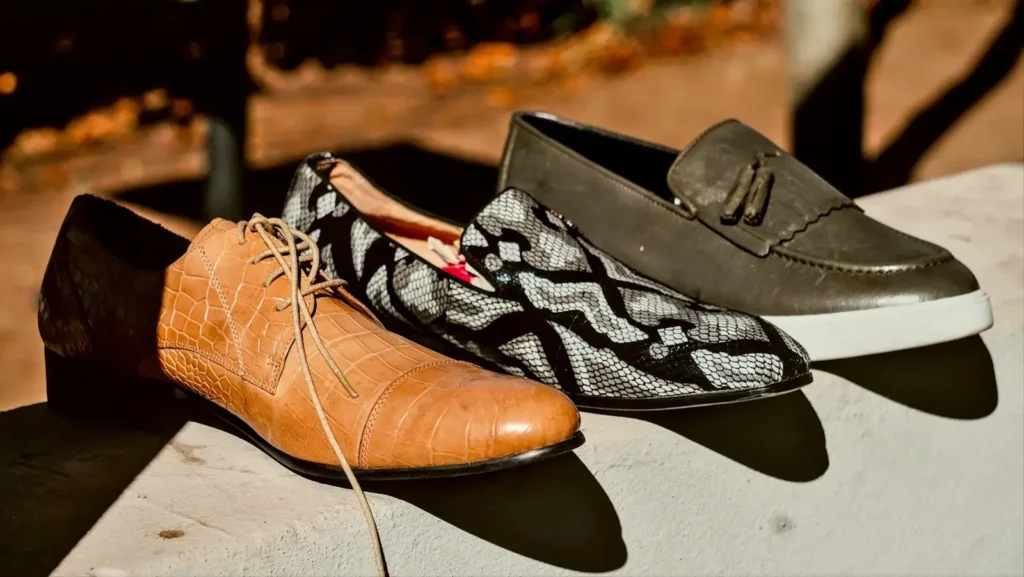
Understand How Shoes Are Made and How Materials Perform
Learn the basic production flow, because knowing how shoes are made tells you exactly where a weak material will fail and which property to test before you buy.
You do not need to run a factory to source well, but you do need to know which stage punishes poor material.
From Cutting to Lasting: Where Material Quality Shows
A shoe moves from cutting and stitching to lasting, where the upper is pulled over the form and bonded to the sole. Materials that look fine on a swatch can tear at the lasting stage, fade under UV, or delaminate under heat and pressure. Our shoe upper material range shows how different uppers behave at each step, which helps you write a spec the supplier can actually hit.
Test Materials Before You Commit
Order physical samples and run the tests that match your use case: flex cycles, colorfastness, water entry, and seam strength. Wear-test a prototype for a few weeks rather than trusting a lab sheet alone. The cost of a sample batch is small next to the cost of a recalled or returned run.
Assess Communication, Transparency, and Stability
Judge responsiveness, supply-chain openness, and financial health early, because a supplier that is slow or opaque before the contract rarely improves after it.
Communication is a leading indicator of everything else. If answers take a week during courtship, they will take a month during a crisis. Press for transparency on where materials come from and whether any step is subcontracted. Ask for references and, for larger programs, a sense of the supplier’s stability through years in business and client retention. A partner that hides its chain or dodges references is a risk you do not need.
Watch for Red Flags
Walk away from suppliers that lead with the lowest price, refuse samples, lack certifications, or dodge direct questions, because those signs predict the problems you will face after payment.
Most sourcing failures trace back to a choice made in the first conversation, not to a defect found months later. A short verification call and a simple document request will surface most of these warning signs before any money moves, so build the check into your screening routine rather than treating it as a formality.
A few patterns show up repeatedly in failed sourcing.
- Price far below market with no explanation of how, which usually means cut corners or hidden substitutions.
- No original certificates and reluctance to name the issuing body.
- Refusal to provide a paid pre-production sample or to agree on an inspection standard.
- Vague answers about factory ownership, subcontracting, or material origin.
- Pressure to pay in full upfront with no track record.
Any one of these is worth a pause; two or more is a reason to keep looking. Keep a written scorecard during screening so early enthusiasm does not crowd out the warnings you noted first.
Build a Long-Term Supplier Partnership
Move from one-off transactions to a standing partnership, because a supplier that knows your line earns you faster samples, steadier quality, and better pricing over time.
The first order is a test for both sides. If it goes well, share forecasts, involve the supplier earlier in design, and negotiate volume terms that reward loyalty. Long relationships also make it easier to ride out material-price swings and capacity crunches, because a partner will prioritize accounts it trusts.
Set a simple review rhythm after each season: compare actual defect rates, lead times, and responsiveness against the contract, and raise gaps while they are small. Share your sell-through data where you can, since a supplier that understands your real demand can hold buffer stock and smooth your reorder cycle. Once the relationship is proven, ask for joint development on new materials instead of only reordering the old ones, which keeps your line moving ahead of competitors.
FAQ
What certifications should a shoe material supplier have?
At minimum, look for a quality management certification such as ISO 9001 and chemical compliance relevant to your market, like REACH for the EU. Specific product types may require a CE marking. Always ask for original documents and verify them against the issuer.
How do I test shoe fabric before placing a bulk order?
Order physical samples and run tests tied to your use: flex endurance, colorfastness, water resistance, and seam strength. Follow up with a short wear test of a finished prototype. Combine your own checks with a third-party pre-shipment inspection using an AQL plan.
What is a reasonable MOQ for custom shoe materials?
It depends on the substrate. Standard textiles often carry lower minimums, while coated or laminated constructions need larger runs. Expect the supplier to quote the MOQ per color and width, and build your first order around a volume you can actually sell before scaling up.