
The fabric used in a shoe does more than cover the foot. It sets the weight, breathability, durability, and look of the final product, and it often decides whether a design survives mass production without tearing at the last stage or fading under sunlight. For buyers, product managers, and brand owners, sourcing that material means working with a shoe fabric supplier who understands both the material science and the hard demands of footwear manufacturing.
The market is crowded with vendors offering similar-sounding products at very different prices, and the gap between a convincing sample and a reliable production run is exactly where most sourcing problems begin. Picking a partner on price alone tends to cost more later, once rejects, delays, and restocking scrambles show up.
The right shoe fabric supplier is the one that matches your material specifications, meets your volume and quality requirements, proves its claims with samples and certifications, and communicates clearly on price and lead times. Define your needs first, then vet every candidate against the same checklist before you place a production order.
The sections below walk through that checklist from the first brief to a working partnership.
Clarify your fabric needs before contacting suppliers.
You should pin down your shoe type, the performance the fabric must deliver, and your expected order volume before you talk to any vendor, because a clear brief is what lets suppliers quote accurately and filter themselves in or out.
A vague request such as “send me your best shoe fabric” invites a pile of irrelevant samples and wasted weeks. The fix is to write a short brief before you send a single message. Keep it simple, but make it specific enough that a competent supplier can respond with real numbers instead of a catalog link.
Match fabric to your shoe type.
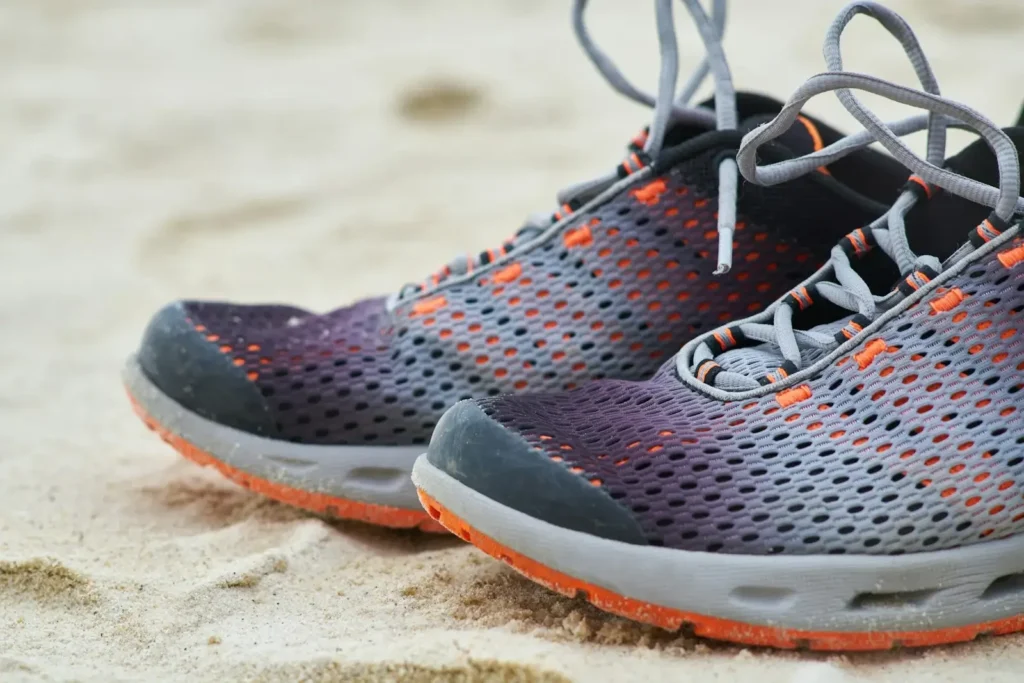
There is no single best fabric for shoes. A running shoe needs a light, breathable mesh that moves with the foot and sheds heat, while a work boot needs a dense, abrasion-resistant textile that holds up to rough daily use. Formal and dress shoes lean on fine woven fabrics for a clean surface and a structured feel, and children’s styles add their own rules around softness and washability.
Before contacting suppliers, write down the shoe category, the wearer profile, and the conditions the shoe faces. That short note becomes the foundation of every conversation and stops vendors from pushing materials that don’t fit your product. For a structured look at how upper materials perform across categories, see our Shoe Upper Materials Guide.
Estimate volume, MOQ, and lead time.
Volume shapes that suppliers can even serve you. A vendor built for container-scale orders may reject a small trial run, while a small workshop may not scale when your bestseller takes off. Estimate your monthly and yearly needs, your reorder cycle, and how fast you must restock once a style sells through. Ask early about minimum order quantities and whether the supplier offers small-batch flexibility for market testing. Knowing these numbers up front saves weeks of back-and-forth later and keeps you from overcommitting capital to a style you haven’t validated.
Understand the main shoe fabric materials
The fabrics you will source mostly fall into three groups—woven and knitted textiles, synthetic and PU-based materials, and waterproof membranes—and knowing how each behaves helps you brief suppliers and judge their suggestions with confidence.
You don’t need to be a chemist to source well, but you do need a working map of the materials on offer. The three groups below cover most upper and lining applications, and each carries its own trade-offs in cost, weight, durability, and processing.
Textiles and woven fabrics
Textiles cover a wide range of weaves, knits, fibers, and weights. Denier measures thread weight; lightweight shoe fabrics often sit around 110D, while 420D and 600D are common in sturdier uppers. Fibers include cotton, nylon, polyester, and blends, each with its own hand feel, strength, and color range. Mesh is valued for breathability in sport and casual shoes, woven oxford cloth gives structure to everyday styles, and knits add stretch where the design calls for it. Our Shoes Upper Material range shows these textiles supplied as finished upper fabrics ready for production.
Synthetic and PU-based fabrics
Synthetic upper materials are usually built in layers rather than as a single sheet. A backing of woven or non-woven polyester carries a surface skin applied through dry or wet lamination. Higher-grade versions start with a microfiber PU backing that cuts cleanly, takes dye, and resists water, with a thin polyurethane skin printed, embossed, or polished into almost any look. The range of colors and textures is large, but custom colors often require meeting a minimum order volume, so factor that into your planning if your brand uses signature shades.
Waterproof membranes and laminates
Performance and outdoor shoes often use a thin membrane laminated between an outer fabric and an inner tricot layer, forming a three-layer construct. Membranes made from PTFE, PU, or TPU block liquid water while letting vapor pass, which is what keeps feet dry without overheating. The quality of the lamination, not just the membrane type, decides how long that protection lasts under repeated flex and wash cycles. For the technical basis of how footwear materials are tested and rated, SATRA publishes widely used industry guidance that many suppliers reference.
The table below sums up how the three groups compare on the points buyers ask about most.
| Material group | Typical use | Key strengths | Main trade-off |
| Woven and knitted textiles | Uppers, linings, casual styles | Breathable, light, wide color range | Less water resistance without treatment |
| Synthetic and PU-based | Sport, value, and fashion uppers | Consistent look, dyeable, cost-flexible | Quality varies widely by backing grade. |
| Waterproof membranes | Outdoor and performance shoes | Blocks water, vents vapor | Higher cost and lamination yield loss |
Where to find reliable shoe fabric vendors
You can reach qualified shoe fabric vendors through B2B sourcing platforms, trade shows, and material exhibitions and through referrals from agents or industry networks, and you should never rely on a single channel when building your shortlist.
Each channel finds a different kind of supplier, so use more than one. A platform may surface exporters you’d never meet locally, while a trade show puts physical samples in your hand. Referrals, in turn, often lead to workshops that don’t advertise at all.
Online B2B directories and marketplaces
Directories let you filter vendors by material type, location, and certifications, and they give a fast first read on a supplier’s catalog and export history. Treat the listings as a starting point, not proof. Open the vendor’s own site, check real product specs, and request documentation before trusting the profile. Watch for recycled photos and vague answers about origin, which are common early warning signs.
Trade shows and material exhibitions
Material fairs put you in front of suppliers and, just as usefully, in front of physical samples you can bend, pull, and compare. Seeing and handling fabric is hard to replace with photos, and show-floor conversations often surface new materials you would never have searched for by name. If travel is tight, at least request swatch packs from shortlisted vendors and run your own simple tests at the bench.
Referrals, agents, and industry networks
A recommendation from a peer who has shipped at volume carries weight that a sales pitch does not. Sourcing agents and industry groups can also widen your reach into regions and factories that don’t market themselves in English. Combine these channels so no single source controls your pipeline, and always keep at least two qualified vendors warm for each critical material.
How to evaluate a shoe fabric supplier
Evaluate each shoe fabric supplier on production capacity, quality control and certification, the sampling process, and communication and financial stability, and use the same checklist for every candidate so your comparisons stay fair.
A consistent checklist is the difference between a feeling and a decision. Write the questions once, send them to every candidate, and score the replies on the same scale. That way you compare like with like instead of favoring the vendor with the smoothest email.
Production capacity and minimum order quantities
Confirm the supplier can hit your volume today and scale when you grow. Ask for current lead times at your actual order size, not at a theoretical one, and clarify the minimum order per color and per style. A vendor whose MOQ sits far above your needs will either tie up capital or push you into overproduction, while one that’s already at full capacity will quietly slip your dates. Request recent order references near your volume as proof.
Quality control and material certification
Ask how batches are tested and what standards they are measured against. Relevant checks include tensile strength, tear resistance, colorfastness, and abrasion, and depending on your market, you may need proof of restricted-substance compliance or specific material certifications. Independent test reports from recognized labs carry more weight than a supplier’s self-declaration, so ask who ran the test and when.
Sampling and prototyping process
Never move to full production on a catalog photo. Order samples, test them in your own build, and confirm the supplier can hold the spec across repeats, not just on the first yard. Clarify who pays for samples, how long they take, and how deviations are handled before you scale up. A vendor that ships a tight, consistent sample set is showing you what production should look like.
Communication, transparency, and financial stability
Clear communication is a leading indicator of a smooth production run. A supplier who discloses subcontracting, answers technical questions plainly, and shares references is easier to trust than one who goes quiet after the deposit. Financial stability matters too, because a vendor that fails mid-contract can stall your whole launch. Short, specific replies during evaluation usually predict short, specific replies during a crisis.
Understand shoe fabric price and cost structure.
Shoe fabric price is driven by fiber type, construction, finishes, and order volume, but the real landed cost also includes tooling, shipping, duties, and material waste, so compare the full cost rather than the per-meter quote alone.
The number on the quote is the start of the math, not the end. Buyers who only compare per-meter prices often get surprised by the gap between the sample invoice and the container invoice, and that gap is where margins disappear.
What drives fabric pricing?
Several variables move the number at once. Fiber and backing choice set the base cost, with synthetic microfiber and technical backings costing more than basic polyester. Construction details such as denier, weave density, and lamination layers add or subtract from it. Finishes like water repellency, dye-to-match, and embossing carry their own charges, and custom colors usually demand higher minimums. The table below shows how each factor tends to push price.
| Pricing factor | How it affects shoe fabric price |
| Fiber and backing | Microfibre and technical backings cost more than basic polyester. |
| Construction | Higher denier and denser weaves raise material and process costs. |
| Lamination | Multi-layer membranes add steps and yield loss. |
| Finishes | Water repellency, dye-to-match, and embossing add per-meter charges. |
| Order volume | Larger, steady runs lower the effective unit price. |
Hidden costs to plan for
The quoted price is rarely the final price. Tooling and cylinders for custom colors, freight and insurance, import duties, and the waste from cutting and defects all stack on top. Cutting loss alone can run several percent of material cost on certain constructions, and rejected batches add the same cost twice. Build these into your model before you compare two suppliers, or you’ll be choosing a number neither one will actually bill.
Balancing cost and value
Cheapest per meter is rarely cheapest overall once returns, delays, and rejects are counted. Weigh price against consistency, lead time, and the supplier’s ability to meet sustainability goals, because those factors shape your total cost and your brand risk. Our Sustainable Footwear Materials piece covers how material choices affect both cost and environmental footprint, which matters more as buyers ask harder questions about what their shoes are made from.
Negotiate terms and build a long-term partnership
Once a supplier clears your checklist, lock in clear contracts, payment terms, and lead times, then protect quality by treating the relationship as a partnership rather than a one-off transaction.
The best commercial terms come from a supplier who wants your repeat business, not just your deposit. That relationship is built in the first contract and maintained in every order after it, so the work doesn’t stop when the signature does.
Contracts, payment terms and lead times
Put the essentials in writing: specifications, accepted quality limits, price, payment schedule, lead time, and who owns which risk if something goes wrong. Standard structures use a deposit with the balance on shipment or receipt, but terms can shift with volume and trust as the partnership proves itself. Clear terms reduce the chance of a dispute when a batch misses a spec, and they give both sides a reference point instead of a debate.
Protecting quality through the relationship
A good first order does not guarantee a good tenth order. Keep testing incoming batches, share feedback quickly, and involve the supplier early when you change a design or switch a fiber. Suppliers who understand your product will flag risks before they become defects, and that feedback loop is worth more than a slightly lower price. Treat the vendor as part of your development team, and the whole pipeline gets steadier.
FAQ
What certifications should a shoe fabric supplier have?
It depends on your market, but useful ones cover restricted substances, flammability, and, for some regions, recycled-content claims. Ask for test reports from recognized labs rather than self-declared compliance, and match the certification to where you actually sell. A cert that means nothing in your target market is just paper.
How do I verify a supplier’s sustainability claims?
Request documentation, not slogans. Ask for material origin, recycled-content percentages, and third-party verification, then sample and test the fabric yourself before committing volume. A supplier confident in its claims will share chain-of-custody detail without hesitation, while a vague answer is itself the answer you needed.
Is it better to source shoe fabric locally or overseas?
Local sourcing cuts lead time and freight risk but often costs more per meter. Overseas suppliers usually win on price and range but add shipping, duties, and longer cycles that strain fast-moving styles. Many buyers start local for trials and move volume overseas once a supplier proves consistent quality across repeats.