When outdoor enthusiasts, tactical personnel, or industrial workers step into ankle-deep water, they expect their footwear to keep their feet bone-dry. However, merely spraying a water-repellent coating onto the outside of a shoe will never provide permanent protection. To achieve true, long-lasting waterproofing that survives thousands of steps in harsh weather, footwear factories rely on an advanced manufacturing method known as waterproof bootie construction.
If you are a footwear developer, production manager, or material buyer, understanding the mechanics of this assembly method is essential for preventing costly factory defects and failed lab tests. In this comprehensive technical guide, we will examine how a waterproof bootie construction works, compare it to alternative methods, and break down the 6 proven steps required to build a flawless waterproof shoe.
What is Waterproof Bootie Construction?
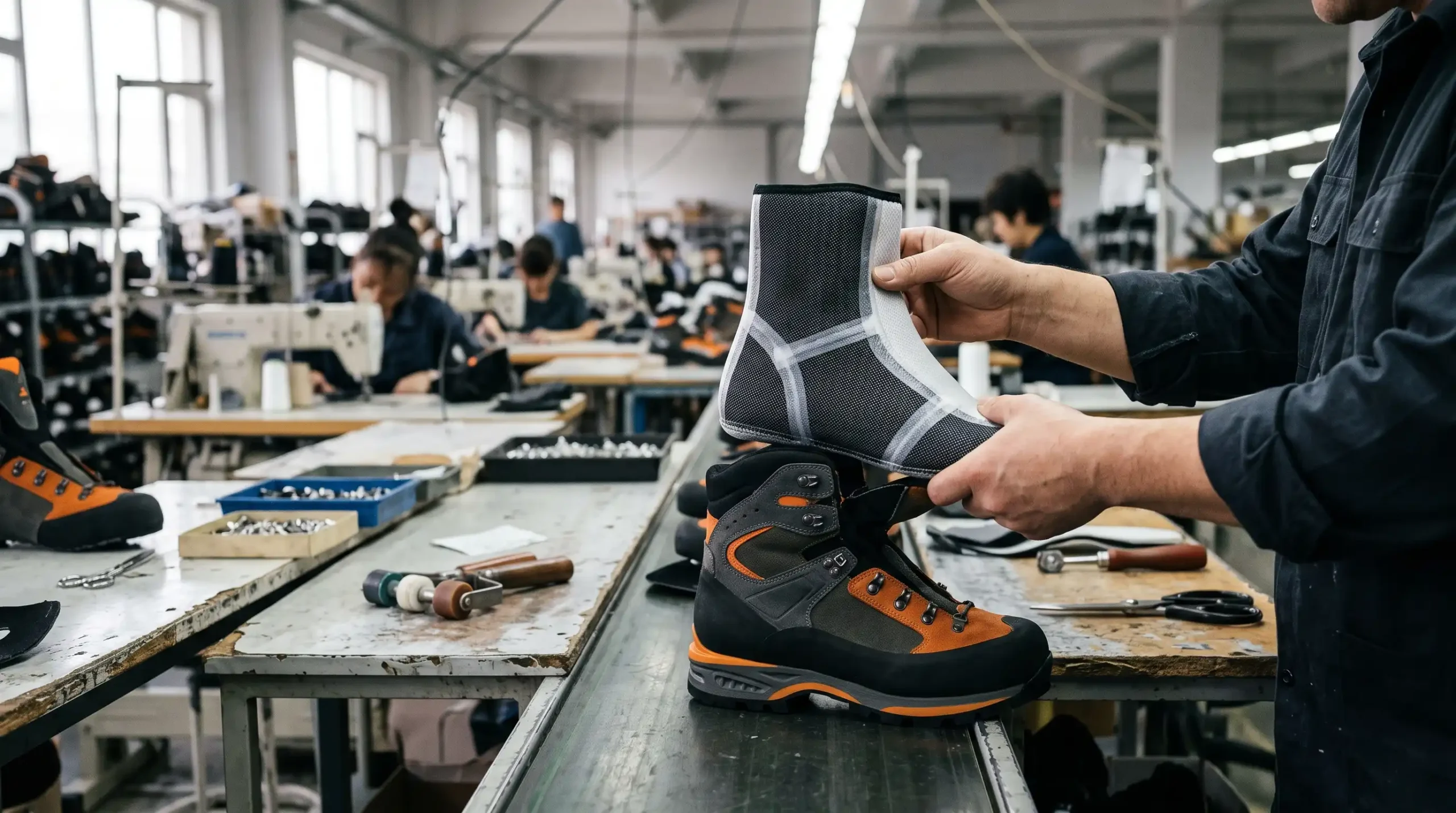
In technical footwear manufacturing, a waterproof bootie construction (often referred to as a “bootie liner” or “membrane sock”) is an assembly technique where a fully sealed, 3D sock-like liner is built separately and suspended inside the outer shoe upper.
Instead of attempting to seal every decorative stitch on the exterior leather or nylon mesh, engineers construct an independent inner barrier using laminated membrane fabrics. This inner sock completely encapsulates the wearer’s foot—from the collar down to the underfoot Strobel board—creating a continuous, impenetrable shield against liquid water while allowing internal sweat vapor to escape.
Full Bootie vs. Half-Bootie (Gusset) Construction
Before cutting materials on the factory floor, footwear designers must decide between two primary structural variations depending on the shoe’s price point and intended application:
- Full 360-Degree Bootie: The membrane package wraps completely around the top, sides, and bottom of the foot like a true sock. This offers the highest level of security against water ingress and is the mandatory standard for heavy-duty mountaineering boots, military footwear, and certified safety boots.
- Half-Bootie (Strobel/Gusset Construction): The waterproof package covers the upper and sides of the foot, terminating at the lasting margin where it is cemented and sealed to a waterproof insole board. While slightly more cost-effective in material consumption, it requires extreme precision during the lasting and cementing phases to prevent leaks along the sole edge.
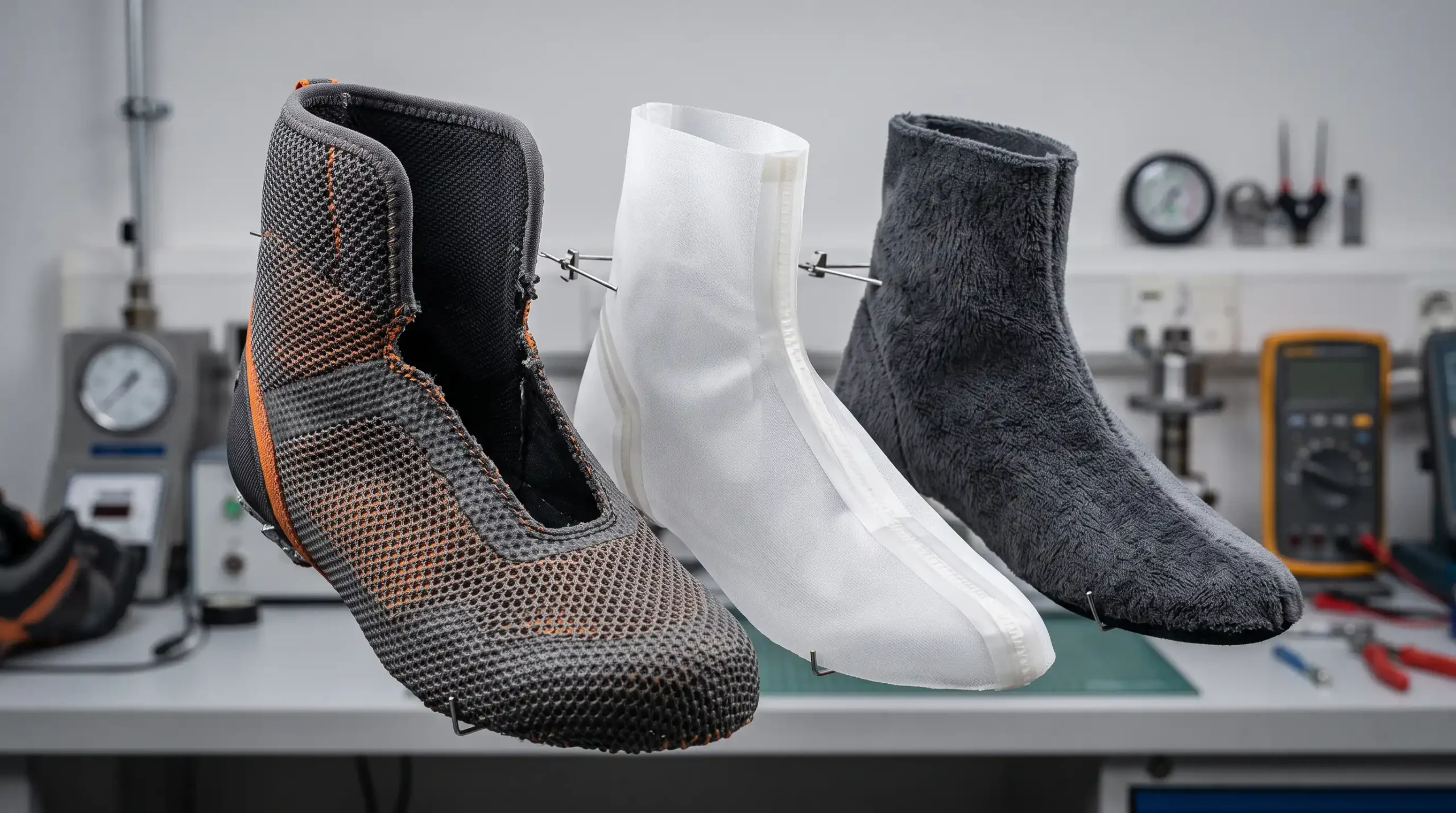
The 6 Proven Manufacturing Steps on the Assembly Line
Executing a reliable waterproof bootie construction requires strict quality control at every stage of production. A single needle puncture or poorly calibrated heat weld will cause the entire shoe to fail. Here are the 6 critical steps used by top-tier footwear factories:
Step 1: Precision Material Selection and 4-Layer Lamination
A raw waterproof film is far too fragile to be sewn into a 3D sock on its own. Material suppliers must first engineer specialized composite shoe materials specifically designed for bootie packages. Typically, this involves a 3-layer or 4-layer lamination: a soft inner lining (like moisture-wicking tricot), a light comfort foam, a high-performance waterproof barrier (such as ePTFE, TPU, or PU), and a protective nylon backing scrim.
Step 2: Pattern Engineering and Stitching the Sock
The laminated bootie fabric is die-cut or laser-cut into precise pattern panels. Because the inner bootie must fit snugly inside the outer upper without wrinkling or creating pressure points on the foot, pattern allowances must be calculated down to the millimeter. Operators then stitch the panels together using specialized sewing machines with controlled needle sizes and thread tension.
Step 3: High-Temperature Hot-Air Seam Sealing
Once the 3D sock is stitched, thousands of tiny needle holes exist along the seams. Workers immediately feed every stitched joint through a hot-air welding machine, applying a thermoadhesive seam sealing tape directly over the backing scrim. The molten adhesive penetrates the stitching and locks onto the membrane layer, permanently sealing every needle hole.
Step 4: Internal Air-Inflation Leak Testing (Pre-Lasting QC)
Smart factories never wait until the shoe is finished to check for leaks. Before the bootie is inserted into the outer upper, it is mounted onto an air-inflation testing rig and submerged in a water tank. Compressed air is pumped inside the sealed sock. If an operator sees a single air bubble escaping from a seam, the bootie is immediately pulled from the line and repaired before expensive outer leather and soles are attached.
Step 5: Hanging, Lasting, and Wicking Prevention
The tested bootie is inserted into the outer upper and pulled over the shoe last. During this stage, two critical rules apply:
- No Punctures: Factory workers must never use metal tacks or staples that pierce through the membrane zone.
- Anti-Wicking Materials: All outer upper materials, threads, and laces near the collar must be treated with hydrophobic finishes. Otherwise, water will “wick” (travel by capillary action) through the outer fabric, climb over the top edge of the bootie collar, and wet the inside of the shoe.
Step 6: Finished Shoe Dynamic Flex Testing
After the outsole is permanently bonded via cement or direct injection, sample pairs from the production batch undergo rigorous centrifugal and dynamic water resistance testing. Mechanical flexometers bend the submerged footwear puluhan thousands of times to verify that the internal adhesive bonds and membrane layers do not delaminate or crack under real-world walking stress.
Build Flawless Waterproof Footwear with Galetex
A waterproof bootie construction is only as reliable as the laminated textile package it is built from. If the membrane delaminates during lasting or lacks the elasticity required to survive hot-air seam taping, your production line will suffer high defect rates.
At Galetex, we specialize in engineering ready-to-sew, multi-layer laminated fabrics tailored specifically for waterproof bootie construction. Whether your factory requires high-stretch TPU bootie packages for athletic trail runners or heavy-duty, abrasion-resistant PTFE laminations for industrial safety boots, our technical team delivers consistent peel strength, verified hydrostatic resistance, and breathable comfort. Contact Galetex today to request material samples and optimize your waterproof footwear production.