When footwear brands claim their hiking boots or safety shoes are “100% waterproof,” they cannot rely on guesswork. To guarantee performance in extreme weather conditions, completed shoes must undergo rigorous laboratory testing. For footwear manufacturers and material sourcing managers, passing a certified footwear water resistance test is the ultimate proof of quality.
If you are developing waterproof footwear, understanding the testing methodologies is just as important as selecting the right materials. In this comprehensive guide, we will break down how the dynamic footwear water resistance test works and explain the critical differences between global standards like SATRA TM77 and ISO 20344.
What is a Dynamic Footwear Water Resistance Test?
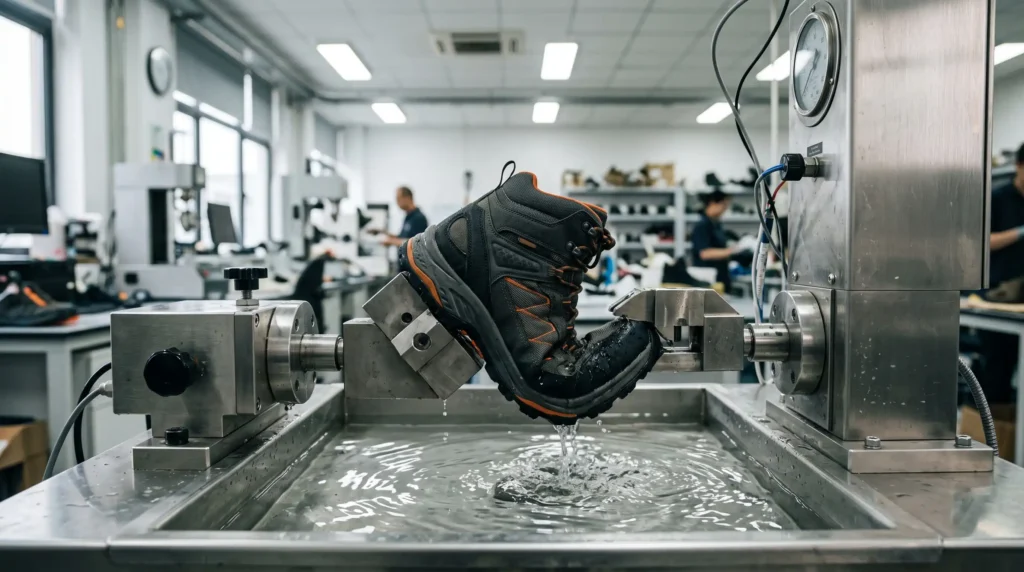
Whole shoe waterproof testing is generally categorized into three methods: dynamic, inflation, and water tank methods. Among these, the dynamic method is the most widely used and applicable to various types of footwear.
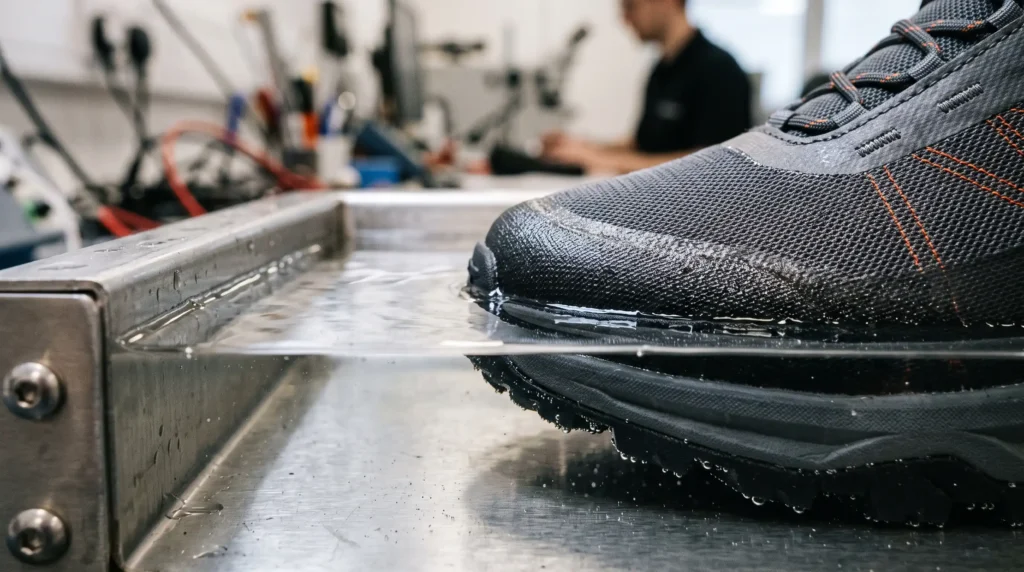
During a dynamic footwear water resistance test, the testing machine flexes the shoe’s forefoot at a set angle and frequency to replicate walking motion while partially submerged in a water tank. This non-destructive method can be applied to finished products without altering their structure. It is the most realistic way to determine if the continuous stress of walking will cause water to breach the shoe’s upper, seams, or membranes.
Key Global Standards for Waterproof Shoe Testing
Different markets and footwear categories require different testing protocols. The two most recognized standards in the industry are SATRA TM77 and ISO 20344.
1. The SATRA TM77 Flex Test
SATRA TM77 specifies a method to evaluate the water penetration resistance of finished footwear under repeated flexing.
- Setup: The shoe is placed in a tray filled with water up to 5 mm above the sole line.
- Action: The machine flexes the shoe at a speed of 140±10 cycles per minute.
- Goal: This test determines the shoe’s ability to resist water ingress during flexing and assesses the durability of seams and materials under dynamic conditions. The test evaluates the number of cycles until a specific penetration area is reached, or the penetration area after a specified number of cycles.
2. ISO 20344 (Section 5.19)
ISO 20344 is predominantly used for the waterproof test of personal protective equipment, such as safety shoes.
- Setup: For Class I shoes, the water level is set 20mm above the lowest feather line.
- Action: The toe flexing angle is up to 45°, and the machine runs at 60±6 cycles per minute.
- Requirement: A standard pass often requires 4,800 cycles over 1 hour of testing with no visible water penetration inside the shoe.
Understanding WR vs. WRU in Safety Footwear
When dealing with occupational footwear, a successful footwear water resistance test dictates the shoe’s official safety rating.
Under the EN ISO 20345:2022 standards, buyers often see the codes WR and WRU (or WPA in updated standards).
- WRU (Water-Resistant Upper): This denotes that the upper material itself resists light rain and splashes, but the entire boot is not completely sealed.
- WR (Waterproof): This signifies that the entire boot features a special membrane behind the upper designed to block water completely, even during dynamic movement. To achieve a WR rating, the boot must undergo the dynamic footwear water penetration test, which bends them underwater for at least 80 minutes. If water ingress is under 3 cm², it is certified waterproof. (Note: The 2022 standard strictly requires no water penetration inside the footwear, whereas the older 2011 test allowed for 3cm²).
Why Material Selection is Crucial for Testing
Passing a rigorous footwear water resistance test is impossible if you start with inferior materials. The membrane must not only be waterproof but also possess high peel strength and extreme flex resistance to survive thousands of mechanical bends in the lab.
Integrating a premium waterproof breathable fabric is the safest way to ensure your footwear passes SATRA TM77 or ISO 20344 standards. At Galetex, we engineer laminated composite fabrics specifically designed to withstand these aggressive dynamic flex tests.
Whether you need a heavy-duty PTFE membrane for tactical boots or a flexible PU membrane for commercial waterproof sneakers, our technical textiles provide the durability and barrier protection required to achieve global waterproof certifications. Ensure your next footwear project passes the test on the first try by partnering with Galetex.