The word waterproof appears on labels that describe very different products. One pair relies on a rubber shell, another on a membrane hidden between upper and lining, a third on nothing more than a factory spray. For buyers and product developers, that ambiguity is expensive, because the same word covers a boot that survives a stream crossing and a sneaker that fails after ten minutes of rain.
Waterproof shoes are made from a layered stack rather than a single fabric: a treated or synthetic upper, a waterproof membrane or coating that blocks liquid water, an inner lining that protects the membrane and moves vapour away from the foot, and a sealed sole unit, held together by taped seams, a gusseted tongue and a water-repellent finish.
Each layer is specified for a different job, which is why the whole assembly, not any one material, decides performance.
A Waterproof Shoe Is a Layered System
No single material makes a shoe waterproof. The upper sheds first contact with water, the membrane stops what gets through, the lining keeps the membrane intact, and the sole unit closes the bottom of the envelope.
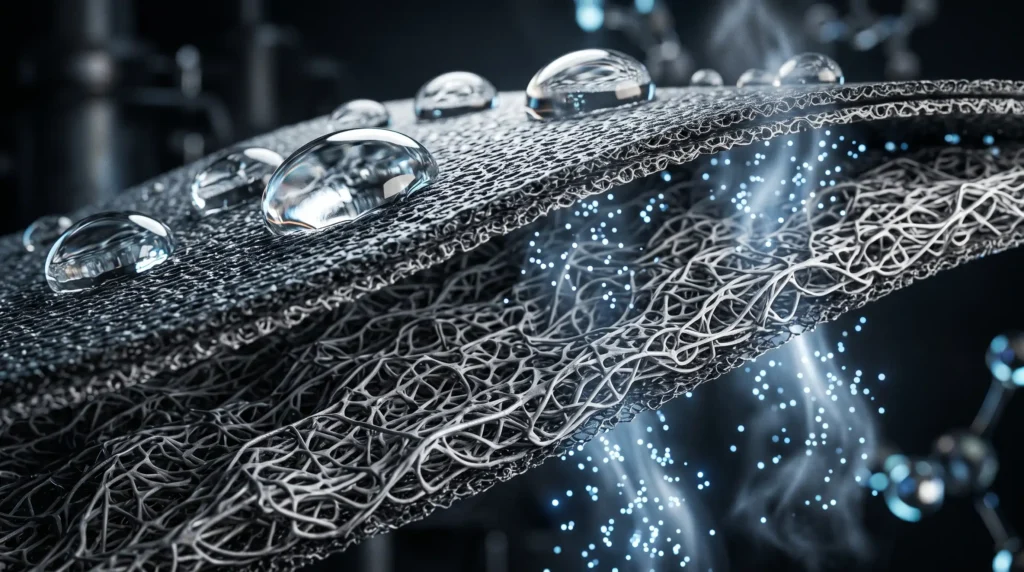
A material that blocks liquid water completely also blocks water vapour, which is why a fully sealed shell becomes a sweaty bag within an hour. Splitting the job lets the outer layer take abrasion and staining, the membrane take pressure, the lining take comfort, and the sole take ground contact and flex.
| Layer | Typical materials | What it does | Failure if compromised |
| Upper | Treated leather, nubuck, polyester or nylon mesh, Oxford fabric, knit, rubber, PVC | Shape, abrasion resistance, initial water shedding | Saturates, gains weight, wicks water inward, abrades the film beneath |
| Membrane or coating | ePTFE film, hydrophilic PU film, TPU film, PU or PVC coating | Blocks liquid water under pressure while passing some vapour | Punctures, delaminates, clogs with oil or detergent |
| Lining and interlayer | Mesh, TC, brushed polyester, foam, wool blend | Protects the membrane, moves moisture, adds structure | Abrades the membrane, holds sweat, drives condensation |
| Sole unit | Rubber, PU, EVA, TPU shank, lasting board | Ground contact, flex, closure of the bottom envelope | Water wicks through the bond line or the lasting board |
A supplier conversation about waterproof material for shoes is therefore a conversation about compatibility. A membrane specified without the upper it will be laminated to, the adhesive that bonds it and the tape that will run over it is a promise, not a specification.
Upper Materials: From Full-Grain Leather to Engineered Mesh
The upper sets durability, weight, breathability and how the shoe behaves in the first minutes of rain, but it rarely provides the barrier itself; its job is to protect the membrane underneath.
Perceived toughness is a poor guide to waterproofing. A well-bonded three-layer mesh laminate often holds a higher hydrostatic head than an untreated leather upper with no membrane behind it.
Leather and Nubuck
Full-grain leather is dense and mildly water repellent, but rain saturates the fibre structure, darkens it, adds weight and eventually passes moisture inward. Waterproof leather footwear therefore relies on an internal membrane plus a repellent finish. Nubuck and suede absorb water faster and need frequent re-treatment, which is why they suit light rain and lifestyle use rather than sustained wet weather.
Synthetic Textiles
Engineered mesh gives the best breathability to weight ratio, which is why athletic and hiking uppers are built on it. Oxford fabric, a plain or basket weave in polyester or nylon, adds tear strength and a cleaner surface for casual and uniform shoes. Ripstop nylon uses a grid of heavier yarn to stop small tears spreading, suiting packable and travel models. A waterproof fabric upper is a finished laminate rather than a raw textile, so the barrier is built in during production and cannot be washed off.
Rubber, PVC and Coated Shells
Rubber and PVC make the shell itself the barrier: continuous, non-porous, with no stitch holes to seal. It is the only construction that stays impermeable regardless of pressure, at the cost of all breathability, plus weight and stiffness. Direct-coated PU or PVC sits in between, cheaper than a laminate but prone to cracking at flex points as it ages.
| Upper material | Water resistance alone | Breathability | Weight | Typical use |
| Full-grain leather | Moderate, needs treatment | Low to moderate | Heavy | Boots, formal, work |
| Nubuck or suede | Low, absorbs quickly | Moderate | Medium | Lifestyle, light rain |
| Engineered mesh | Low alone, high when laminated | High | Light | Running, hiking |
| Oxford fabric | Low alone, high when coated or laminated | Moderate | Medium | Casual, uniform |
| Knit | Very low alone | Very high | Very light | City, travel |
| Rubber or PVC shell | Complete | None | Heavy | Rain boots, industrial |
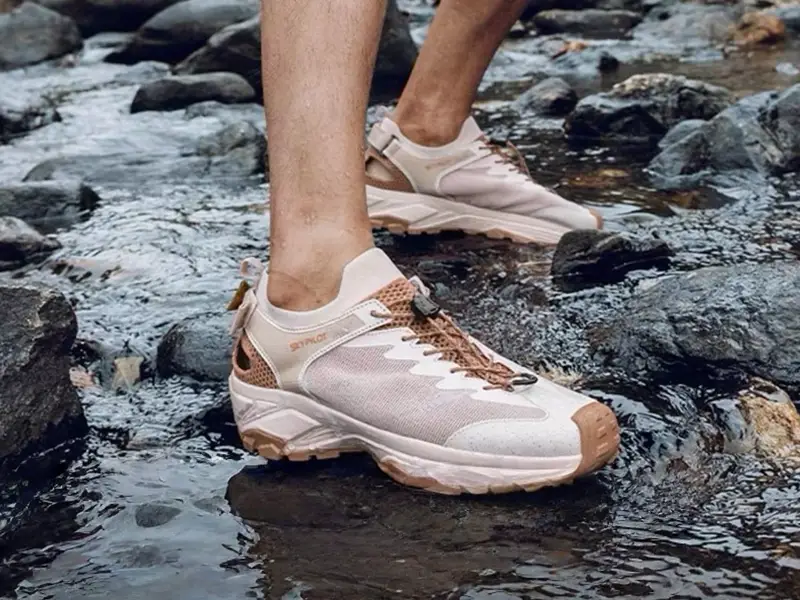
The Membrane: The Layer That Does the Heavy Lifting
The membrane is the layer that actually stops liquid water, and its specification, not the upper material, sets the performance ceiling of a waterproof shoe.
It appears in footwear as a full bootie inside the upper, as a film laminated behind the face fabric, or as a direct coating. A bootie seals the whole foot volume including tongue and collar but adds bulk and demands careful lasting; laminates are lighter and more flexible, which is why most performance sneakers use them.
Microporous ePTFE
Expanded PTFE is stretched into nodes and fibrils holding billions of pores per square centimetre, far smaller than a water droplet and far larger than a vapour molecule. It delivers the best combination of pressure resistance and breathability available in footwear and holds up across temperature extremes and repeated laundering. The drawbacks are cost, a microporous surface that needs protection from oils and detergents, and regulatory pressure on the material family in some markets. A PTFE waterproof membrane is usually the top specification tier in a range.
Hydrophilic PU
Polyurethane has no pores at all. Hydrophilic segments in the polymer chain absorb vapour on the humid inner side and release it on the drier outer side by diffusion. With no open channels, the film resists pressure and contamination from sweat salts and detergents very well, but vapour transfer depends on the temperature gradient and hydrolysis degrades the film over a product’s life.
TPU
Thermoplastic polyurethane behaves like PU with a sturdier polymer backbone: more elastic, better flex fatigue, functional at lower temperatures, and bondable with dot-pattern adhesives that keep the hand feel soft. It has become the mainstream mid-range choice because it approaches ePTFE on pressure resistance at lower cost and processes easily without solvents.
Is There a 100% Waterproof Fabric?
No woven or knitted textile is waterproof by itself. Fabric is interlaced yarns with gaps between them, and water crosses those gaps once capillary action or pressure beats surface tension. Only an added continuous film, a coating heavy enough to close the structure, or a rubber shell changes that. Even then, “100%” describes a pressure threshold rather than a permanent property. Waterproofness is measured by raising a column of water against a sample until it penetrates, recorded as the hydrostatic head in millimetres under ISO 811, the standard hydrostatic pressure test for textiles. A material that holds 10,000 mm is not absolutely waterproof; it is waterproof up to the pressure that column represents.
| Membrane type | Mechanism | Pressure resistance | Breathability | Cost |
| ePTFE | Microporous, size exclusion | Very high | Very high | High |
| PU | Hydrophilic, non-porous | High | Moderate, temperature dependent | Low to moderate |
| TPU | Hydrophilic, non-porous, elastic | High | Good and stable | Moderate |
| PU or PVC coating | Continuous film, direct coated | Moderate | Low | Low |
Linings, Foam and Lamination
Lining and interlayer materials are not waterproof, but they decide whether the membrane survives, whether the shoe feels dry inside, and whether the laminate holds together after a season of flexing.
A membrane is a film a few microns thick with almost no strength of its own, so it must be supported. Two-layer builds bond it to the face fabric and cover it with a loose lining; three-layer builds bond both faces into one handleable composite that is easier to cut, stitch and last, which is why they dominate volume production.
Bonding matters as much as membrane choice. Solvent adhesives are cheap but leave residue that affects odour and compliance, while solvent-free PUR hot melt in a dot pattern gives controlled peel strength with almost no volatiles. Peel strength, wash durability and flex cracking are where laminates fail, not in the film itself.
Lining materials handle comfort rather than protection. Plain mesh or TC linings are durable but hold little moisture; brushed polyester and wool blends feel warmer and buffer sweat; closed-cell foams stay dry, while wet open-cell foam keeps the inside of the shoe damp long after the rain stops.
Construction Details That Decide Whether It Leaks
A good membrane in a badly built shoe leaks, and a mid-range membrane in a well-sealed shoe does not; seams, tongue, collar and sole bond line matter more than the film.
A membrane covers a surface, but a shoe is a three-dimensional object with openings, overlaps and needle holes.
Seams and Seam Tape
Every stitch through a waterproof layer creates a hole, and a boot upper can carry several hundred. Heat-applied PU or TPU tape closes them from inside. Coverage matters more than presence: tape that stops short of a seam end, lifts at a curve or bridges a change in thickness leaves an open path, and tape is usually the first thing to fail at the ball of the foot.
Tongue and Collar
The tongue is the largest unsealed opening in most shoes. A free flap lets water running down the laces pass straight behind it, while a gusseted or bellows tongue closes the opening and is a reliable sign of a genuine waterproof build. The collar sets the immersion limit, since nothing stops water pouring in over the top.
Sole Attachment
Water also arrives from below and from the sidewall. A cemented construction depends on the adhesive bond, and a skip in the cement line becomes a capillary channel; injection-moulded and vulcanised soles eliminate that joint on the perimeter. A bootie extending under the lasting board closes the bottom of the envelope, while one that stops at the lasting edge leaves the footbed exposed to water drawn up through the sole.
Are Waterproof Shoes Actually Waterproof?
Yes, a properly built pair blocks liquid water from entering through the upper and sole under normal walking pressure, and no, your feet are not guaranteed to stay dry, because moisture arrives from four other directions.
Condensation comes first: feet sweat continuously, a barrier slows its escape, and warm humid air condensing on a cooler membrane soaks the sock, so many leaking complaints are really breathability complaints. Second is top entry over the collar or down a trouser leg. Third is saturation and wicking, where a soaked leather or textile upper carries water along laces, stitching and lining without ever crossing the membrane under pressure. Fourth is degradation: PU hydrolysis, abrasion at the flex zone, pores clogged by detergent residue, perished tape. Good sealing carries its own cost, because a waterproof shoe that floods dries far more slowly than a breathable one. In warm conditions at high output, a fast-draining non-waterproof shoe can be the more comfortable choice.
How Can You Tell If Shoes Are Waterproof?
Check three things together: a named membrane or barrier, seams described as taped or sealed, and a stated hydrostatic head rating. A product missing any of them is almost certainly water resistant, not waterproof.
The terms are loosely regulated, but ratings are measurable and map onto real conditions.
| Protection level | Hydrostatic head | What it handles |
| Water repellent | Around 100 mm or unstated | Light mist, brief drizzle |
| Water resistant | Around 200 mm | Light rain, damp pavement |
| Waterproof | 1,000 mm and above | Rain, shallow puddles, light snow |
| Highly waterproof | 5,000 mm and above | Heavy rain, wet trails, slush |
| Professional grade | 10,000 mm and above | Extreme and prolonged wet conditions |
Four further checks separate a real claim from a hopeful one. Confirm that a barrier is named and its position in the construction described. Read the seam language, since taped, sealed or welded means something while a vague reference to waterproof stitching usually does not. Inspect the tongue, because an ungusseted one is an open door above the instep. Ask whether whole-shoe testing was done, because a flat material sample cannot predict how a shoe behaves when it flexes and abrades. Independent footwear research and testing bodies such as SATRA run dynamic walking and whole-shoe penetration methods for exactly that reason. To field-check a pair you already own, stand it in about 5 cm of water with a dry paper towel inside: dampness at one consistent spot suggests a construction defect, while uniform dampness across the footbed suggests condensation.
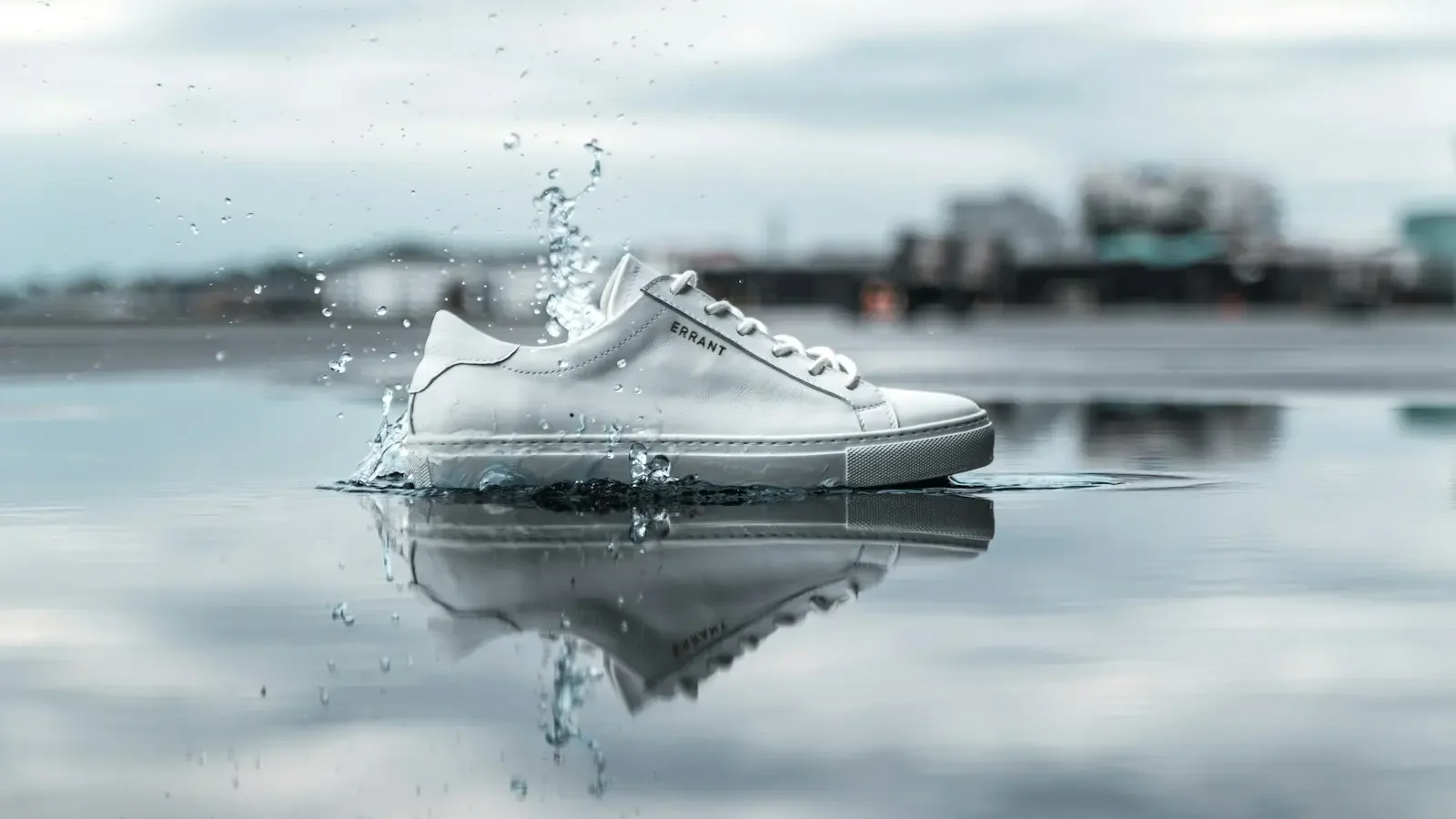
Can Any Shoe Be Made Waterproof?
Almost any shoe can be made more water resistant, but only footwear with the internal volume, lasting method and seam access to hold a barrier can be genuinely waterproof, and retrofitting a light canvas or mesh shoe rarely justifies the cost.
Aftermarket sprays and waxes raise surface tension so water beads and rolls off. They help in light rain, keep the upper from saturating and reduce staining, but the gaps between yarns stay open, the coating wears away with abrasion and cleaning, and nothing reaches the seams, tongue or sole bond. The factory route builds the barrier into the construction: a bootie is inserted and lasted, seams are taped, the tongue is gusseted, the lasting board is sealed and the sole is attached so the perimeter closes. That changes the pattern, lining, last and assembly sequence, so it belongs at development stage rather than after approval. Shoes with internal volume and stitched or cemented builds adapt well; very thin, highly curved or slip-lasted shoes do not, because there is no room for a bootie and no flat surface for tape to bond to.
For brands planning a waterproof line, the order should be the performance target, then membrane chemistry matched to climate and price band, then the upper and lining designed as a laminate, then sealing and sole attachment. Engaging Custom Shoes Material Services at that first step is what usually keeps a waterproof line on schedule.
Frequently Asked Questions
These three come up most often once a buyer moves from material selection to real-world wear.
Why does a waterproof shoe start leaking after six months?
Rarely the membrane. Look for seam tape lifting at the flex point, an upper that has lost its repellent finish and now wicks water along the lining, or detergent and body oils clogging a microporous film. Cleaning and re-treating restores most of the performance; damaged tape or film needs repair.
Can waterproof shoes go in a washing machine?
Most should not. Agitation and spinning stress tape and laminate bonds, and ordinary detergent leaves hydrophilic residue that can clog pores. Hand wash with a soft brush and a mild technical cleaner, then air dry away from direct heat.
Is a membrane or a coating more durable?
A membrane. Bonded films flex with the shoe, while coatings crack at crease lines and thin under abrasion. Coatings are cheaper and simpler to produce, but a laminated membrane with sealed seams holds its rating longer on a daily-worn shoe.