Most footwear programs fail at the upper, where a supplier’s cheapest substitution is easiest to hide and where returns surface first. Buyers approve a hand feel at sampling, then find at bulk that a 400D mesh shipped as 200D, that a coating cracked at the flex line, or that a hide lot cut out at 62 percent yield against a costing built on 75. Choosing from a shoes upper material range is therefore a specification task before it is a materials task.
There is no single best material for shoe uppers. The best upper satisfies four constraints at once: the wear environment it faces, the construction your factory uses, the landed cost your retail price can carry, and the standards your destination market enforces. Leather wins on longevity and shape retention, coated synthetics and microfiber win on consistency and yield, and mesh and engineered knit win on breathability and weight. Any claim that one family leads across all four is marketing, not engineering.
The sections below compare each family and the numbers to agree before a bulk order is released.
What Makes a Shoe Upper Material the Best Choice?
A shoe upper is best when its weakest property still clears the requirement of its worst-case use at a cost the program can absorb. The decision starts with a failure mode, not a material name: identify what will destroy the shoe first, then choose the family that resists that failure most cheaply.
The shoe upper is not one part: vamp, quarters, toe cap, heel counter, eyestay, tongue. Each zone sees different stress. The toe cap abrades, the flex line folds tens of thousands of times, and the counter must stay rigid while the collar stays soft. A material that performs in one zone can be wrong in another, which is why most commercial uppers are hybrids.
Costing puts the upper near a third of manufacturing cost and close to half of stitching line time, so a 5 percent change in yield moves retail price further than the same change in sole cost. Four constraints belong in the brief:
- Wear environment. Climate, surface, load, and hours per wear.
- Processability. Can it be cut, stitched, and lasted on your line?
- Landed cost. Roll price divided by yield, plus labor, plus likely defects.
- Compliance. Restricted substances and category standards.
What Are the Main Shoe Upper Materials?
Six families cover almost every commercial shoe upper: full-grain and split leather, coated split leather, polyurethane, microfiber, mesh, and engineered knit or woven textile. They divide into two logics: sheets cut from hides or rolls, and textiles cut from roll goods or knit to shape.
| Shoe upper material | Chosen for | Main risk to specify against |
| Full-grain leather | Shape retention, aging, premium hand | Shade variation, scars, 60 to 75 percent yield |
| Split or coated leather | Uniform surface at lower cost | Finish adhesion, flex cracking |
| PU synthetic | Low cost, wide embossing range | Hydrolysis, delamination, low vapor transfer |
| Microfiber synthetic | Uniformity, abrasion life, yield above 90 percent | Fiber grade and PU ratio cut at bulk |
| Mesh | Airflow, low weight, drainage | Low tear strength when unreinforced |
| Knit or canvas | Fit, fewer cut-and-sew steps, printability | Stretch recovery, pilling, shrinkage |
Sheet-Based Uppers: Leather, Coated Leather, PU and Microfiber
Sheet materials are bought by area and cut by knife or die, so yield is the first commercial variable. Full-grain leather has the highest tear strength and best shape memory, but no two hides cut alike. Coated split leather buys uniformity at the cost of breathability and can separate at the flex line if adhesion is under-cured. Microfiber sits between them, and its isotropic non-woven base lets components nest in any direction, which makes yields of 90 to 95 percent realistic. Fiber grade and PU content are what to lock in the order.
Textile Uppers: Mesh, Engineered Knit and Canvas
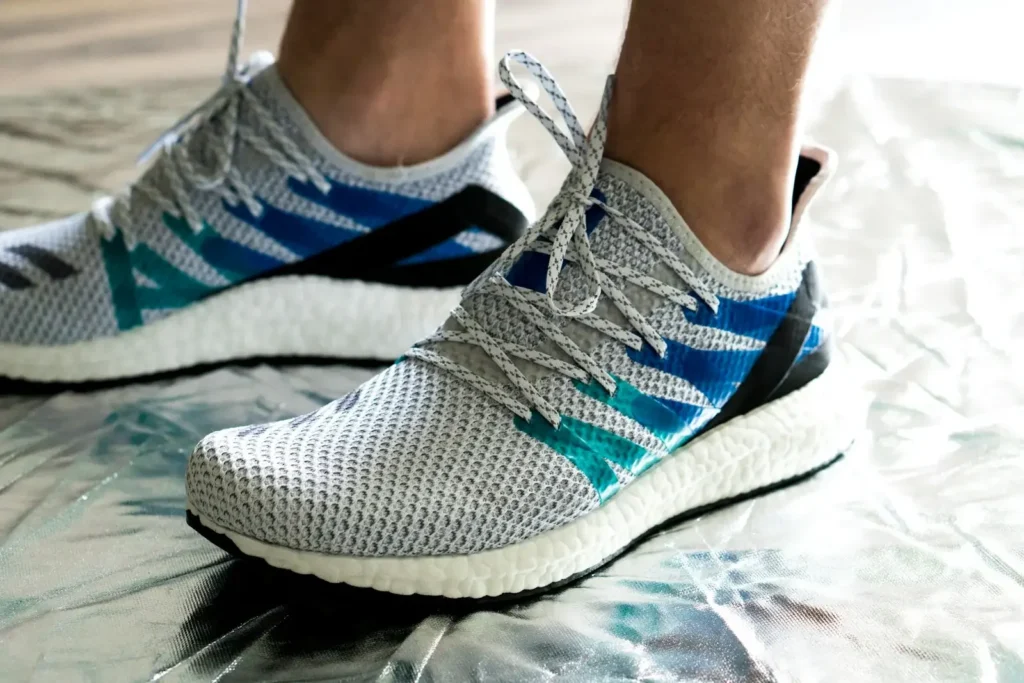
Textiles are chosen when airflow and weight matter more than structure. The controlling variable is yarn size in denier, where a higher number means a heavier yarn. A 400D and a 200D mesh can carry the same print, but the tear strength gap separates a shoe that survives a season from one that returns. Where a program needs airflow plus integrity, a three-layer mesh fabric bonds mesh, membrane, and inner tricot into one laminate handled as a single sheet.
Engineered knit shapes zones during knitting: dense where support is needed, open where airflow is. It removes cut-and-sew steps and fits a wider range of foot volumes, but it stretches, so lasting tension becomes a quality variable. Canvas is cheapest, though cotton absorbs water and fades.
How Do the Main Upper Materials Compare?
Among shoe upper materials, no family leads on every criterion. Breathability and abrasion resistance trade directly against each other, and the materials that hold shape best move air least. The useful comparison is not which material scores highest, but which criterion your product cannot compromise.
| Criterion | Strongest options | What to watch |
| Breathability | Open mesh, engineered knit | Falls sharply with a membrane or heavy coating |
| Abrasion and tear | Full-grain leather, microfiber, ripstop | Unreinforced fine mesh at toe and flex line |
| Weight | Monofilament mesh, knit | Lighter usually means thinner, not stronger |
| Water resistance | Membrane-laminated textile, coated sheet | A coating resists splash, not standing water |
| Shape retention | Leather, microfiber, dense knit with overlays | Knit relaxes; PU creases permanently |
| Cost per pair | Canvas, standard PU | Roll price is not pair cost; yield decides |
The breathability gap is measurable. A 2022 controlled trial of 40 older wearers found that large-hole mesh uppers produced smaller foot skin temperature swings and lower in-shoe humidity change than synthetic leather and laminated uppers under the same protocol, which is the mechanism behind the comfort complaints that drive returns in warm markets. Where a product ships to a hot, humid region, breathability belongs in the performance brief, not the feature list.
Which Upper Material Suits Each Shoe Type?
Match material to shoe type first, then to price point. Running needs low weight and vapor transfer, lifestyle and court shoes need structure and clean surfaces, outdoor and work footwear need abrasion resistance plus a waterproofing path, and formal shoes need shape retention.
| Shoe type | Typical upper | Key requirement | Thickness |
| Road running | Engineered mesh, monofilament, knit | Low weight, vapor transfer, heel hold | 0.4 to 0.8 mm |
| Lifestyle and court | Coated synthetic, microfiber, split leather | Toe-drag abrasion, color consistency | 1.2 to 1.6 mm |
| Hiking and outdoor | Nubuck, ripstop nylon, laminate | Tear strength, water and scuff resistance | 1.4 to 1.8 mm |
| Safety and work | Full-grain leather, reinforced textile | Puncture and abrasion resistance | 1.8 to 2.2 mm |
| Formal and dress | Full-grain or corrected-grain leather | Shape retention, crease recovery | 1.0 to 1.4 mm |
Safety footwear is the one category where the upper requirement is written into a standard rather than negotiated. ISO 20345 sets minimum upper tear strength at 30 N for leather and 15 N for coated and textile materials, so a lightweight textile upper is compliant only if the test report shows it. Ask for that report at material stage, not after first bulk.
Can the Three-Shoe Rule Shape a Brand’s Upper Range?
The three-shoe rule comes from wardrobe advice: one everyday pair, one formal pair, one active pair. Applied to development rather than to a closet, it constrains how many upper specifications a brand needs. A tight lifestyle line can run on three platforms: a breathable textile for warm-weather styles, a coated or microfiber sheet for structured everyday shapes, and a leather or leather-look sheet for the formal end. Each carries several colorways, so the brand manages three sets of test reports instead of a dozen.
How Should the Upper Pair With Lining, Membrane and Sole?
The upper cannot be specified alone. The lining controls moisture at the skin, the membrane controls water entry, and the sole construction controls how the upper is attached and how much structure it must supply itself.
Lining matching is where most comfort complaints start. A dense, low-permeability upper paired with a non-wicking lining traps moisture. Open mesh moves vapor but abrades at the heel, leather regulates moisture at higher cost, and brushed fabric holds water when ventilation is poor. The range under shoes lining material follows one rule: the lower the upper’s vapor transfer, the more breathable the lining.
Waterproofing is a stack, not a hero material. A durable water repellent finish sheds rain and buys time, but standing water needs a membrane behind the upper, usually rated above 10,000 mm hydrostatic head. A waterproof fabric upper is a laminate for this reason: the face resists abrasion, the membrane blocks water, and the backing protects it during lasting.
EVA or Rubber, PU or TPR: Which Sole Pairs With the Upper?
These are sole questions, asked here because the layers are chosen together and the upper’s stiffness decides what the sole must offset.
| Sole material | Strength | Limitation |
| EVA | Very light, cushions, cheap to mold | Compresses and loses rebound under load |
| Rubber | Grip, abrasion life, water resistance | Heavy, higher processing cost |
| PU | Resists compression, dense support | Heavier and firmer than EVA |
| TPR | Lowest tooling cost, molded unit soles | Stiffens in cold, limited wet grip |
EVA beats rubber on weight and cushioning while rubber beats EVA on wear life and traction, so most performance footwear uses both: an EVA midsole under a rubber outsole. PU is the engineering choice where compression set matters, TPR the commercial choice where tooling cost drives the program. A thin knit on a heavy unit feels unbalanced, so pairing is a balance decision as much as a cost one.
What Belongs on an Upper Material Spec Sheet?
A shoe upper specification is only real if it carries test methods and target values. Without them, the approved sample and the bulk shipment are two products that happen to look alike, and the buyer has no contractual basis to reject the second.
| Property | Test basis | Typical target |
| Tear strength | Tongue tear method | 30 N or higher for leather, 15 N for coated and textile |
| Abrasion resistance | Martindale | 25,600 cycles or higher for daily-wear uppers |
| Flex resistance | Flexometer, repeated flexing | No cracking at the category cycle count |
| Colorfastness | Grey scale, rubbing and light | Grade 4 or higher |
| Moisture vapor transfer | Cup method | Above 1,500 g/m2/24h for hot-climate product |
| Hydrostatic resistance | Rising water pressure | Above 10,000 mm where a membrane is specified |
| Elongation | Tensile at fixed load | Under 15 percent at 50 N to hold lasted shape |
Chemical compliance belongs on the same sheet. Uppers sold into the European Union must clear REACH restrictions on hexavalent chromium, azo dyes, and phthalates, with a report per production lot.
Consistency is how a good specification quietly degrades: yarn can drop from 400D to 200D and coating weight can fall by grams, none of it visible on a swatch. The controls are unglamorous: a yarn count clause in the order and sealed bulk samples held against the approved standard.
How Do Cutting Yield, MOQ and Labor Change the Answer?
The material with the lowest roll price is frequently the most expensive per pair. Yield, stitching labor, and defect rate move pair cost more than the quoted unit price, and they scale with order size.
| Material | Cutting yield | Order size profile | Labor profile |
| Full-grain leather | 60 to 75 percent | Hide based, size and grade dependent | High: skiving, edge folding, matching |
| Coated or PU sheet | 85 to 90 percent | Roll based, color minimums per lot | High: multi-panel cutting and stitching |
| Microfiber sheet | 90 to 95 percent | Roll based, moderate color minimums | Medium: fewer defects to cut around |
| Engineered knit | 95 percent or higher | Style based, programming per pattern | Low assembly, higher development cost |
| Mesh and canvas | 80 to 90 percent | Roll based, low color minimums | Medium |
Pair cost for a shoe upper reads as material price divided by yield, plus labor minutes at line rate, plus expected defect and warranty cost. It changes decisions: a leather at a premium price with 65 percent yield and heavy matching can lose to a microfiber at a higher roll price with 93 percent yield and a single-panel layout. Yield earns its premium when a style has many panels and a wide color range.
FAQ
Three questions come up after the specification is agreed, and each one changes a number on the sheet above.
Are knit uppers suitable for wide feet or high insteps?
Knit is generally the most accommodating upper for a wide forefoot or high instep, because it stretches and recovers around the foot rather than resisting it. Mesh is reasonably accommodating in sandwich and jacquard constructions, while ripstop and coated synthetics are stiffer and leather conforms only after break-in. Knit offers less lateral support, so pair a wide-fitting last with a denser knit.
How much validation time should be reserved before releasing bulk?
Plan for a wear trial and a lasting trial as separate tests. The wear trial answers whether the material survives real use; the lasting trial answers whether it survives your line, since a stiff material can tear at the heel curve while an elastic one will not hold shape. Where a membrane is involved, add a finished-shoe water test, since material data does not predict seam performance.
Do recycled or bio-based upper materials lose durability?
Not inherently, but the burden of proof shifts to the supplier. Recycled polyester mesh and recycled-content microfiber can match virgin performance when the yarn specification holds, and the usual failure is a specification change smuggled in beside the sustainability claim. Require the same tear, abrasion, and flex data as the virgin version.