Two samples of the same style can arrive at a buyer’s desk looking identical and still differ by 80 grams per shoe. The difference is never visible in a photo, because it lives in the bill of materials: a face fabric 40 g/m2 lighter, a foam 0.06 g/cm3 less dense, one backing layer removed. For footwear brands and sourcing teams, weight is decided on paper long before any tooling is cut, which is why the question of what lightweight shoes are actually made of is a specification question rather than a marketing one.
Lightweight shoes are built from four weight-saving material families working together: a thin engineered mesh or knitted textile upper instead of leather or heavily coated fabric, a low-density foam midsole such as standard EVA, compression-molded EVA or a supercritical foam, a reduced or blown rubber outsole instead of a full solid rubber bottom, and a slim lining and membrane package. No single material makes a shoe light. The grams come from removing layers, lowering foam density and cutting component count across the entire bill of materials.
This guide breaks that bill of materials down layer by layer, from the textile on the outside to the foam under the heel, and shows where each gram can realistically be removed.
What Counts as a Lightweight Shoe?
There is no formal industry standard, but the working convention among footwear developers is a single shoe under roughly 300 grams (10.6 ounces) in a men’s size 9, with lightweight trainers landing between 200 and 280 grams and competition shoes below 200 grams.
Weight only means something once the measurement convention is fixed, and most disputes about a “lightweight” claim are really disputes about sampling. A pair weight is roughly double a single shoe weight, a women’s size 7 is lighter than a men’s size 9 in the same build, and quoted figures often exclude the insole. The practical rule is to compare single-shoe weight at a stated size and state whether the insole is included. Developers chase these numbers because of energy cost: research summarized in Frontiers in Physiology puts the penalty at roughly 1 percent more running energy per 100 grams added per shoe, which is why lightweight material for shoes is specified by weight rather than by name on a sample card.
| Category | Typical weight per shoe | Typical build |
| Competition and racing | 150-200 g | single-layer mesh, supercritical foam, minimal rubber |
| Lightweight trainer | 200-280 g | engineered mesh, single-density foam, blown rubber |
| Standard trainer | 280-350 g | layered mesh, dual-density midsole, full rubber |
| Heavy or protective | 400 g and above | coated or leather upper, dense midsole, solid rubber |
Which Upper Textiles Keep a Shoe Light?
The lightest uppers are single-layer engineered mesh and circular-knit textiles in the 120 to 200 g/m2 range, followed by thin synthetic microfiber at 200 to 260 g/m2 and coated oxford at 180 to 240 g/m2. Leather, suede and heavily coated fabrics start above 300 g/m2 and rarely appear in a sub-280 gram shoe.
The upper typically accounts for 30 to 40 percent of total shoe weight, so it is the first place a developer looks. Textiles are quoted by area weight, but the number that reaches the scale belongs to the finished laminated panel: a 150 g/m2 mesh becomes a different component once a 60 g/m2 backing and a 40 g/m2 adhesive are bonded to it. Buyers comparing a shoes upper material range should therefore ask for finished laminate weight in writing.
Woven Mesh Against Knitted Upper
Woven mesh holds its shape and takes a clean edge, but it cannot stretch over a last, so it needs more panels and more seams. A knitted one-piece upper removes most of that cut-and-sew labor, which is why a knit build can drop 20 to 30 grams. The trade is structure: knit uppers usually need hot-melt yarns or a fusible heel counter, and those additions eat part of the saving.
Backing, Coating and Lamination Weight
Most weight surprises originate in lamination. A 160 g/m2 face fabric with a 40 g/m2 adhesive and a 70 g/m2 backing arrives at 270 g/m2 before a single cut, so the finished upper is nearly 70 percent heavier than the fabric it was specified from. Coating adds weight the same quiet way. The lever is usually the backing: a 30 g/m2 nonwoven in place of a 70 g/m2 knit, or a hot-melt adhesive at 25 g/m2, saves weight without touching the visible surface.
Which Midsole Foams Remove the Most Grams?
Supercritical foams and PEBA are the lightest midsole options at 0.07 to 0.12 g/cm3, foamed TPU and compression-molded EVA sit in the middle, and standard EVA remains the heaviest common choice at 0.15 to 0.30 g/cm3. Density is the only specification that reliably predicts midsole weight.
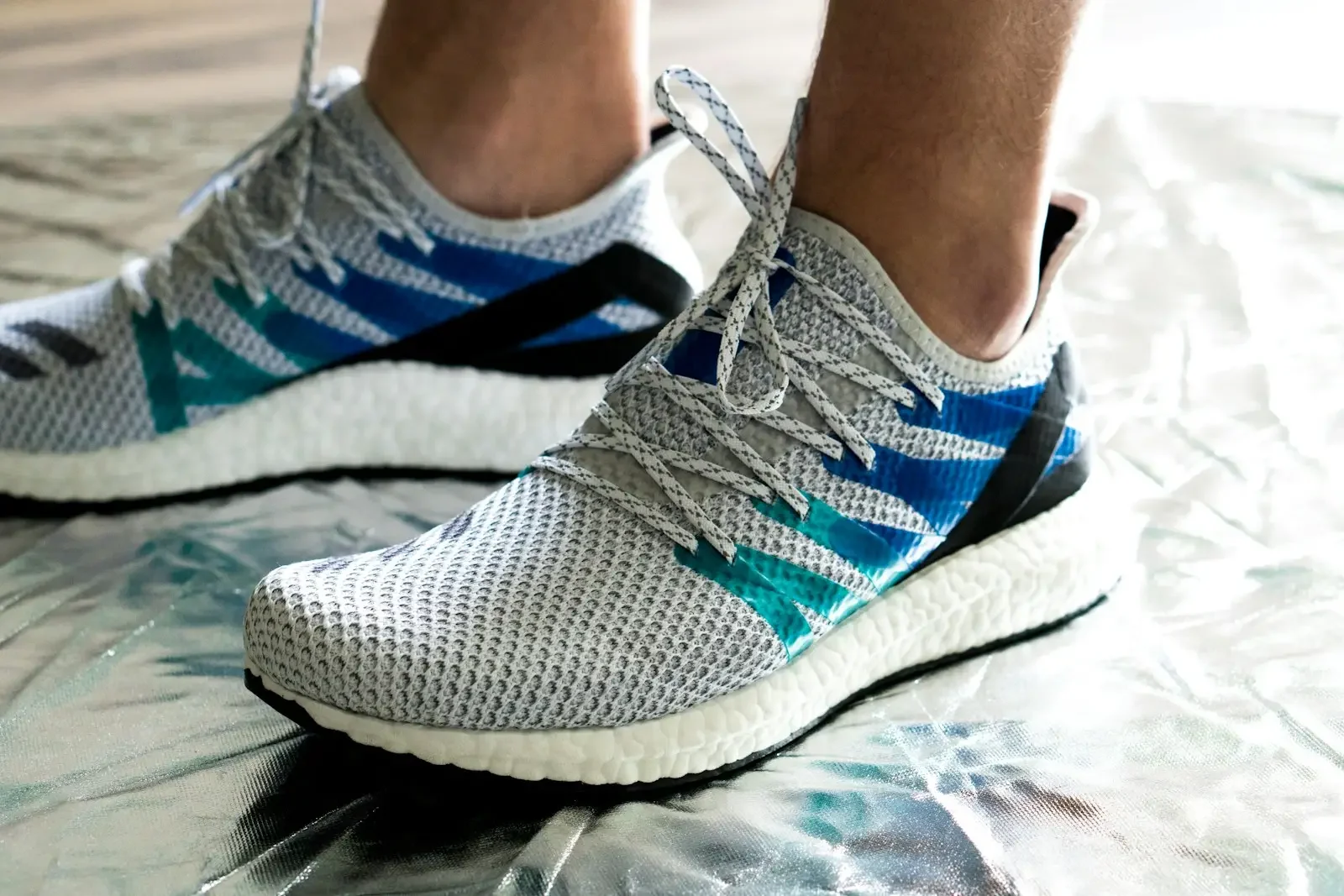
The midsole is frequently the single heaviest component in a lightweight shoe, at 25 to 35 percent of total weight, and it is also where the most useful trade-off sits. Lower density buys grams and loses compressive strength at the same time, a relationship documented in foam research published in Polymers, where compressive stress tracked density closely across every sample tested. A developer choosing a 0.10 g/cm3 foam is choosing a softer, lighter, faster-compressing midsole, and the design response is usually a thicker stack with a firmer heel insert rather than a uniform block.
| Foam | Density (g/cm3) | Rebound |
| Standard EVA | 0.15-0.30 | 40-45% |
| Compression-molded EVA | 0.18-0.25 | 50-60% |
| Supercritical EVA | 0.08-0.12 | 80% and above |
| Foamed TPU | 0.24-0.26 | 70-80% |
| PEBA | 0.07-0.10 | 80-85% |
Where the Outsole and Bottom Stack Add Weight
The outsole is the hardest place to remove weight, because abrasion resistance and compound density move together. The realistic levers are coverage area, thickness and compound choice, not a new material: solid rubber at 1.1 to 1.3 g/cm3 can be replaced by blown rubber at 0.6 to 0.8 g/cm3, or by a partial-coverage layout that leaves foam exposed in low-wear zones.
A full solid rubber outsole on a men’s size 9 trainer can weigh 110 to 140 grams on its own, more than half the budget of a 250 gram shoe. Blown rubber cuts that by 30 to 40 percent and gives up some abrasion life, which is fine in a road shoe and unacceptable in a trail or work model. Coverage is the other lever, and the standard approach is a decoupled layout: rubber pods under the heel and forefoot, exposed foam in the midfoot where the foot does not contact the ground.
- Full rubber outsole: maximum durability, highest weight
- Blown rubber outsole: 30 to 40 percent lighter, shorter wear life
- Partial rubber pods over exposed foam: lightest practical hybrid
- EVA or TPR outsole: light and inexpensive, limited abrasion resistance
Below the outsole, the rest of the bottom stack is easy to forget. The lasting board, the shank, the insole and the strobel stitching all sit under the foot and are usually quoted separately by different suppliers.
Linings, Membranes and Insoles: The Hidden Grams
Lining, membrane and insole together commonly add 40 to 70 grams per shoe, and they are the components most often missing from a buyer’s weight calculation. A three-layer package of face fabric, microporous membrane and lining is the standard lightweight waterproof build, and each layer can be specified by weight.
The membrane is rarely the problem. A microporous or hydrophilic membrane typically runs 15 to 25 g/m2, and even a three-layer Mesh Fabric laminate built for waterproof footwear stays far lighter than the leather it replaces. The weight hides in the other two layers: a brushed lining at 120 g/m2 versus a 60 g/m2 mesh lining is a 30 gram difference across a pair, and a 3 mm foam collar at 30 kg/m3 adds grams that no one itemizes. Insoles follow the same logic: a molded EVA footbed at 45 grams is common, and a thin fabric-covered one at 20 grams performs adequately in a casual shoe.
Lining performance is not optional even in a light shoe. ISO 20345, the safety footwear standard, sets minimum lining requirements including tear strength of 30 N for leather and 15 N for coated and textile linings, plus water vapour permeability of at least 2.0 mg/(cm2 h). Specifying a shoes lining material by weight and performance figure, rather than by hand feel, keeps a lightweight build from turning fragile.
Weight Against Durability: Where to Reinforce and Where to Remove
Remove grams from low-wear panels and put them back into the heel counter, the toe bumper and the outsole heel, because abrasion and structural failures cluster in a small number of zones. A shoe that is uniformly thin fails early; a shoe that is thin where nothing rubs lasts as long as a heavier one.
Field returns in lightweight footwear follow a predictable pattern, and the fix is almost always local rather than global. The heel counter collapses when the upper is too soft, the toe box scuffs through when the mesh has no overlay, and the outsole heel wears through first because that is where the strike lands. Keeping a 0.8 mm thermoplastic heel counter and a 0.6 mm toe overlay costs perhaps 12 grams and prevents the failures that make a light shoe feel cheap.
| Zone | Typical failure | Lightweight reinforcement |
| Heel counter | Collapse, slip at the collar | 0.8 mm thermoplastic sheet, internal |
| Toe box | Scuff breakthrough | 0.6 mm hot-melt overlay, printed |
| Outsole heel | Abrasion through the foam | Rubber pod, 3 to 4 mm |
| Eyestay and lacing | Tear at the eyelet | Woven tape or knit densification |
| Flex zone at the ball | Cracking of coating | Uncoated mesh, no film in the flex line |
What Is the Healthiest Material for Shoes?
The healthiest material is not a fiber but a specification: a breathable lining that stays dry, low-residue chemistry behind it, and an adhesive system with low volatile emissions. Certified textile lining, chrome-free or vegetable-tanned leather, and water-based adhesives are the practical choices, whatever the fiber.
Material health comes down to what touches skin and what off-gasses during wear. Breathability matters first, since a lining that holds moisture keeps the foot warm and macerated. Chemistry matters second: restricted substance lists under EU REACH cover azo dyes, free formaldehyde and certain heavy metals, and OEKO-TEX Standard 100 certification is the usual way a supplier proves compliance without disclosing the formulation. Adhesives are the most overlooked item, because a solvent-based cement in a closed shoe can leave residual emissions for weeks.
Recycled content belongs in the same conversation, with one caveat: mechanically recycled polyester performs close to virgin polyester in a mesh or lining, but it is not automatically lighter.
What Makes a Shoe Healthy for the Foot
Material is only half of the answer to what makes a shoe healthy for the foot. The other half is geometry, decided by the last rather than the fabric. A toe box wide enough to splay, a heel drop low enough to keep the calf from shortening, a firm heel counter and a flex point that lines up with the ball of the foot do more for foot health than any fiber choice. Cushioning cuts both ways too: well-cushioned midsoles reduce running energy cost by 3 to 4 percent, but the foam that delivers it is the mass a lightweight build is trying to remove.
FAQ
Three questions come up repeatedly once the specification is agreed, and each one points at a decision the bill of materials cannot make on its own.
Which brands make the lightest shoes?
Brand is a weak predictor of weight, because every large manufacturer builds from 150 gram racing shoes to 400 gram protective models. Compare within a category and at a stated size instead: check the single-shoe weight, confirm whether the insole is included, and look at foam density rather than the marketing name. A supplier that can quote density and laminate weight is more useful than any ranking.
Are lightweight shoes less durable?
Only where the grams came out of a wear zone. A shoe lightened by removing backing layers, switching to blown rubber or thinning the lining lasts as long as its heavier equivalent, because the parts that fail first, the outsole heel and the toe box, were left intact. One lightened by thinning the outsole uniformly or dropping the heel counter fails early, and the difference shows in returns rather than lab tests.
Can lightweight shoes be waterproof?
Yes, and the penalty is smaller than most buyers expect. A microporous membrane at 15 to 25 g/m2 plus a low-absorbency lining adds roughly 20 to 40 grams per pair. The larger risk is construction: every seam and lasting edge is a potential leak path, so a waterproof lightweight shoe depends more on seam sealing and lamination quality than on the membrane.