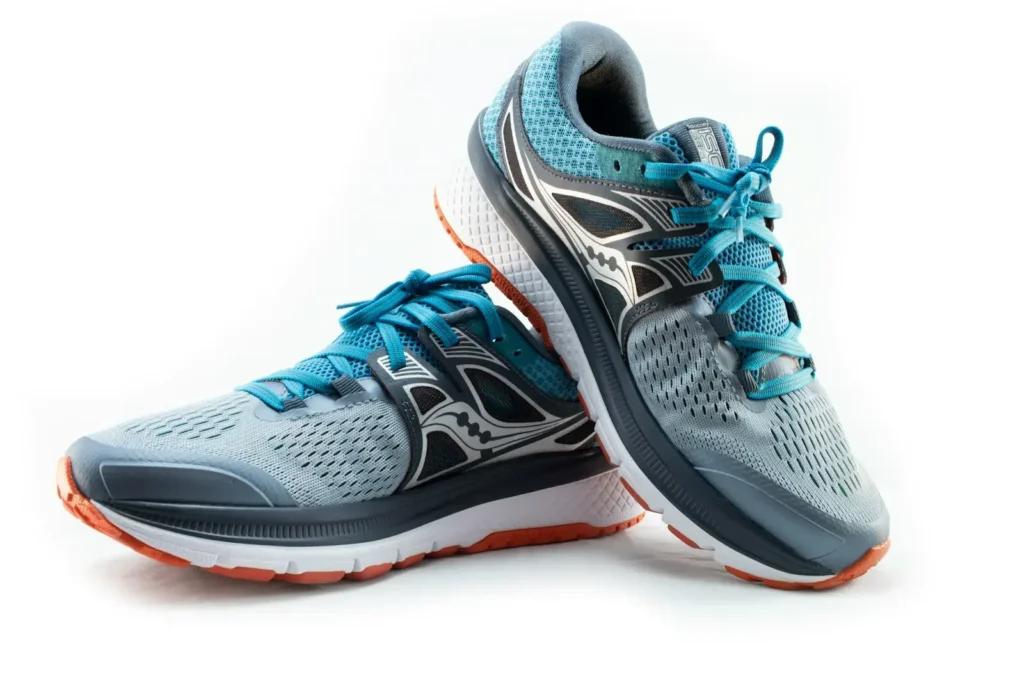
Running footwear development has shifted most of the upper’s structural work out of stitched panels and into the textile itself. A current road shoe upper is often one engineered mesh carrying four or five weave densities, a bonded film cage around the midfoot and a knit collar. For buyers comparing shoe upper materials, the decision is a bundle of competing properties: airflow against abrasion resistance, stretch recovery against lockdown, and drying speed against water resistance. Programs that get the balance wrong find out late, when the eyelet row tears at month three or the forefoot feels like a sealed bag at mile twenty.
No single shoe fabric wins across every running category, but engineered mesh is the best default for road running shoes and most athletic footwear: it combines high airflow over the toes, denser structure through the midfoot, fast drying and a landed cost that holds at volume. Circular knit is stronger when seamless comfort and forefoot accommodation matter more than lockdown, mono-mesh and lightweight woven ripstop belong on racing and trail models where mass and tear resistance dominate, and microfiber synthetic leather or TPU film belong in the specification as reinforcement rather than as the main upper.
The sections below work through those trade-offs by fabric family, by hidden component, and by the test methods that decide whether a specification survives production.
What Fabric Is Best for Running Shoes?
Engineered mesh is the best running shoe fabric for most development programs, because one jacquard construction can open the weave above the toes, tighten it through the midfoot and reinforce the eyelet row without stacking heavy overlays. It dries faster than knit, holds shape over a training block and prices predictably once yarn and zone densities are fixed.
The word engineered describes a process, not a property. A mill sets different densities and open areas across one width, so two fabrics both sold as engineered mesh can differ more than either differs from a knit. A usable specification therefore names the zones: grams per square meter at the vamp, midfoot and collar, plus the yarn in each.
| Fabric | Airflow | Stretch recovery | Abrasion | Where it belongs |
| Engineered mesh, zoned jacquard | High, zoned | Moderate | Moderate to high | Daily trainers, long runs |
| Circular knit | High in open zones | High | Moderate, snags | Comfort-first trainers |
| Mono-mesh | Very high | Low | Low to moderate | Racing, hot-weather work |
| Woven ripstop | Moderate | Low | High | Trail uppers, toe panels |
| Microfiber synthetic leather | Low | Low | High | Heel counters, toe caps |
Yarn choice explains the rest. Polyester absorbs under one percent of its weight in water, resists ultraviolet yellowing and costs less than nylon at equal linear density. Nylon 6.6 brings higher tear and abrasion resistance but takes on roughly four percent moisture and dries more slowly, so it usually sits in reinforcement zones rather than across a whole vamp.
Engineered Mesh, Knit, and Woven: How the Three Core Upper Fabrics Differ
The three core running shoe fabrics differ in how they carry load. Engineered mesh varies density zone by zone, knit carries load through loop geometry and stretch, and woven fabric carries it through interlaced yarns that barely move. That difference explains most of the fit, durability and cost outcomes that follow.
Engineered Mesh
A jacquard loom builds the upper as one piece, with open hexagonal areas over the toes, a denser twill at the midfoot and a closed structure at the eyelets. The gradual transition avoids the hard edge a stitched overlay creates. The trade-off is engineering time: every zone change costs a loom setup, so a five-zone upper rewards programs that can commit to volume.
Circular Knit
A circular knit builds the upper from interlocking loops, giving stretch in every direction and a seamless interior. It is the easiest to step into and the hardest to hold in place once warm and damp, because loop geometry relaxes under load. Heat setting and a denser tuck stitch at the midfoot recover most of the lockdown; an internal strap or a bonded cage recovers the rest.
Woven Ripstop and Jacquard Woven
Woven fabric resists stretch along warp and weft, so it holds a precise shape and a sharp toe box with almost no reinforcement. A ripstop grid interrupts tear propagation, which is why trail uppers lean on it. The cost is accommodation: a woven upper does not expand over a wide forefoot, and a badly placed seam becomes a pressure line.
Linings, Collars, and Tongues: The Fabrics Runners Rarely See
The lining decides blister risk and heel durability more often than the upper does, and it is the first component downgraded to protect a target price. A lining that pills or a collar foam that hardens ends a shoe’s service life while the visible upper still looks new.
Good shoe lining material is a brushed or warp-knit polyester with a smooth face against the sock, enough bulk to hide seam allowances and colorfastness to sweat. The heel needs its own specification, because the counter edge abrades through the lining long before the outsole wears out. Where a shoe carries a membrane, the lining also protects it from abrasion and from the seam ridges underneath.
| Component | Typical fabric | Failure to specify against |
| Heel lining | Brushed polyester knit | Abrasion through to the counter |
| Collar and tongue | Open-cell foam with knit face | Compression set, foam hardening |
| Sockliner cover | Polyester mesh | Pilling, odor retention |
| Tongue backing | Lightweight tricot | Wrinkling, slip under laces |
Waterproof and Water-Repellent Fabrics for Wet-Weather Running
Water resistance in running shoe fabrics is a lamination decision, not a textile decision. The face textile only sheds water until its finish wears; everything after that depends on the membrane, the adhesive and the seam sealing behind it.
Three routes cover most wet-weather programs. A durable water repellent finish on a woven face is the cheapest and lightest, and it survives a few dozen wash cycles before wetting out. A two-layer laminate bonds a membrane to the face and leaves a loose lining inside, which is flexible but lets the lining shift. A three-layer construction bonds face, membrane and tricot together, giving the most stable hand and the best resistance to delamination at the highest cost per meter. A three-layer mesh fabric built on an open mesh face with a moisture-permeable membrane is the usual answer for a road shoe that has to breathe as well as block rain.
Two numbers matter: hydrostatic head and moisture vapor resistance. A three-layer laminate for sustained rain typically tests above 10,000 mm, while a shower shell can sit near 3,000 mm. Vapor resistance uses the RET scale, where lower is better: under 6 is highly breathable, 6 to 13 is wearable for steady running, and above 13 turns a shoe into a sauna at tempo pace. Drying time is the metric most programs forget, and it matters more than peak waterproofing for a shoe worn on consecutive days.
How Running Shoe Fabrics Are Tested and Specified
A fabric specification is only as good as the method behind each number, and the common failure in running footwear is quoting a test that measures a different stress from the one the shoe will see. Lab values rank materials; they do not predict service life.
The gap between a running shoe fabric data sheet and the finished shoe appears in three places. Martindale abrasion runs a flat specimen against a standard abradant, so it never reproduces the concentrated load at an eyelet. Tear tests measure a clean specimen, not one with a needle hole in it. Airflow is measured on a free sample, while the finished shoe closes that path with lining, foam and overlays. Reading each number with its blind spot in mind separates a specification from a marketing claim.
| Property | Method | What the number misses |
| Abrasion | Martindale, ASTM D4966 or ISO 12947 | Behaviour once bonded to foam |
| Tear | Elmendorf, ISO 13937 or ASTM D2261 | Tear at a seam or eyelet |
| Flex | Repeated flex, ISO 7854 | Crease recovery after sweat and heat |
| Airflow | ISO 9237 | Ventilation in the closed shoe |
| Vapor transmission | ISO 11092 or ASTM E96 | Effect of the membrane underneath |
| Hydrostatic head | ISO 811 | Needle holes, seams, flex fatigue |
Matching Fabric to Shoe Category, Sport, and Climate
The best material for sport shoes depends on the loading pattern of the sport rather than on the fiber. Running rewards airflow and fast drying, court sports reward abrasion resistance and lateral support, gym and studio shoes reward stretch recovery, and outdoor shoes reward tear and water resistance.
A daily trainer wants a zoned engineered mesh at roughly 180 to 260 grams per square meter, with a denser midfoot and a soft heel lining. A racing shoe trades structure for mass and drops to 90 to 140 grams, usually on mono-mesh or an open knit, accepting a shorter service life. A trail shoe adds a woven ripstop panel and a rubberized toe bumper. Court shoes barely use mesh: they need a coated woven or synthetic leather face that survives sliding, plus a reinforced medial panel. Gym shoes sit between, with a knit upper and a TPU heel clip.
Climate changes the ranking more than most buyers expect. In hot and humid conditions an open mesh upper with a thin lining keeps skin temperature and humidity swings smaller than a synthetic leather or laminated upper; a controlled trial of 40 older adults recorded foot temperature variation of 1.3 to 3.3 C with mesh against wider swings on denser uppers. In cold and wet conditions the ranking reverses: a tighter weave, a membrane and a heavier lining beat maximum airflow, because a wet foot loses heat far faster than a dry one.
What Is the 3 Shoe Rule and What Does It Mean for Fabric Durability?
The 3 shoe rule is a rotation guideline, not a formal standard. It holds that a regular runner should keep three pairs in service, each with a different role, so no single midsole is loaded on consecutive days and each pair has time to decompress and dry between runs. A narrower reading treats it as a replacement interval of roughly 300 to 500 miles.
The three roles are usually a daily trainer for most mileage, a lighter or plated shoe for faster sessions, and a cushioned shoe for long runs. The logic is mechanical: foam recovers most of its compression within hours but needs roughly a day to return close to its original state, and a shoe worn daily never gets that window. Drying matters as much, because a damp interior softens adhesives and accelerates lining wear.
The durability data explains why rotation changes the economics rather than the total mileage. In a controlled study of rearfoot-strike runners, heel cushioning fell by 16 to 33 percent after 480 km, and the same runners could not reliably feel the loss even after 640 km. The practical conclusion for a running shoe fabric program is that the midsole, not the upper, sets the service limit at around 500 to 800 km. Overbuilding the upper past that point adds cost and mass without usable life; the better investment is a lining and heel area that survive as long as the foam does.
Sourcing Running Shoe Fabrics: What to Ask a Supplier
A running fabric supplier should be qualified on four things: the yarn and construction behind the sample, the test reports behind each claim, the lamination and bonding capability in house, and color and batch consistency at production volume.
A short question list covers most of the risk:
- Which yarn, in which zone, at which weight per square meter, stated line by line rather than as one average.
- Which test house produced the abrasion, tear and airflow reports, and on which specimen size.
- Whether lamination, hot-melt bonding and seam sealing happen on site or through a subcontractor.
- What the color tolerance is across lots, and whether the lab dip was approved on the final construction.
- How the fabric behaves after three wash cycles and after two weeks of compression in a carton.
- What the minimum order is per construction, color and zone combination.
Points one and six decide the real cost. A zoned upper with four densities and a custom color is a different product from a stock mesh, and a supplier who answers both precisely is worth a second sample round. Buyers who want a benchmark can compare how a shoe fabric supplier structures sampling, testing and production commitments before the first order.
FAQ
Three questions come up after the fabric family and the test plan are settled.
What fabric weight should a running shoe upper use?
Racing uppers typically sit at 90 to 140 grams per square meter, daily trainers at 180 to 260, and reinforced zones such as the eyelet row at 250 to 320. Linings run 60 to 110 grams. Treat these as starting ranges rather than targets, since yarn and construction change how a given weight behaves.
Do recycled polyester running fabrics last as long as virgin polyester?
They can, provided the recycled polymer reaches a comparable intrinsic viscosity and the feedstock is clean. Mechanical recycling shortens polymer chains, so a heavily recycled stream needs tighter process control than a bottle-to-fiber stream. Ask for abrasion and tear data on the recycled construction, not the virgin equivalent.
What is the minimum order for custom running shoe fabrics?
A stock mesh in a custom color usually starts in the low hundreds of meters, while a new zoned jacquard needs a loom setup and starts at 500 to 1,000 meters per color. Development sampling is charged separately and credited against the first bulk order.