Sourcing fabric is one of the first commitments a footwear brand makes when planning a new collection, and the numbers attached to that order shape everything downstream. Before a single shoe upper can be cut or a lining can be stitched, buyers need to know how much material a factory will accept per order and how long the roll goods will take to arrive. The challenge is that MOQ and lead time policies vary widely across shoes fabric manufacturers, which makes production planning harder for teams working on tight seasonal schedules.
Most shoes fabric manufacturers set a minimum order quantity of 300 to 1,000 meters per color or design, and some flexible suppliers accept as little as 100 meters for stock fabrics. Typical lead times run 7 to 10 days for in-stock materials, 15 to 20 days for custom-dyed fabrics, and 20 to 30 days for newly developed or laminated fabrics, counted from deposit payment to ex-factory delivery.
The sections below explain how MOQ and lead time work in practice, what ranges to expect for different order types, which factors move these numbers, and how to plan your orders around both.
What Is MOQ When Ordering From Shoes Fabric Manufacturers?
MOQ, or minimum order quantity, is the smallest amount of fabric a manufacturer will accept for a single production run, and for shoe fabric it is usually expressed in meters per color or per design. Factory MOQs in this industry commonly fall between 300 and 1,000 meters per color, because dyeing, finishing, and lamination equipment all lose efficiency at smaller volumes.
Understanding why these minimums exist makes them easier to negotiate. A dyeing machine processes a fixed bath volume, and whether it holds 300 meters or 3,000 meters, the same setup, color matching, and cleanup costs apply. The same logic holds for knitting and weaving machines, coating lines, and lamination equipment, each of which carries a fixed preparation cost per production run. When a buyer orders below the economic batch size, the manufacturer either absorbs a loss on the run or must price the fabric high enough to recover its fixed costs, which is why small orders often carry a premium per meter rather than a lower total price.
How MOQ Is Quoted
The way a manufacturer structures its MOQ affects your real total commitment:
- Per color or per design, not per order. If the MOQ is 500 meters per color and your shoe uses five colors, the total order is 2,500 meters even though no single color exceeds the minimum.
- Linear meters versus kilograms. Woven, coated, and laminated shoe fabrics are quoted in linear meters, while some knitted fabrics are quoted by weight, which changes how you compare suppliers on price.
- Stock versus developed fabrics. Fabrics already in serial production carry the lowest MOQs, while anything requiring new yarn, new tooling, or custom finishing carries the highest.
Typical MOQ Ranges For Shoe Fabric Orders
Expect a MOQ of 100 to 500 meters per color for in-stock shoe fabrics, 500 to 1,000 meters per color for custom-dyed standard constructions, and 1,000 meters or more for newly developed, laminated, or fully customized fabrics. The more development work an order requires, the higher the minimum climbs.
The table below summarizes the ranges buyers most commonly encounter:
| Fabric Type | Typical MOQ |
| In-stock fabrics, standard colors | 100 to 500 meters per color |
| Custom-dyed standard fabrics | 500 to 1,000 meters per color |
| Newly developed or laminated fabrics | 1,000 meters or more per color or design |
The type of fabric also moves the minimum. A custom shoes upper material built from a laminated three-layer construction requires more machine setup and testing than a plain woven lining, so its MOQ sits at the top of the range. Sample orders sit outside these minimums entirely: most manufacturers provide small swatches free of charge and sell one to five meter sample cuts, which lets you test hand feel and construction before committing to a bulk order.
What Is Production Lead Time For Shoe Fabric?
Production lead time is the period between placing a confirmed order and the finished fabric being ready for delivery, and for shoe fabric it typically runs 7 to 10 days for stock orders, 15 to 20 days for custom-dyed fabrics, and 20 to 30 days for newly developed constructions. Most manufacturers start this clock when the deposit payment is received, not when the inquiry begins.
In supply chain management, lead time is conventionally defined as the time from the moment an order is placed to the moment the goods are ready for delivery. For a fabric order, that window is made up of distinct stages:
- Order processing and production scheduling, typically one to three days, while the factory assigns a production slot.
- Raw material preparation, including yarn, base fabric, and chemical sourcing for the specific order.
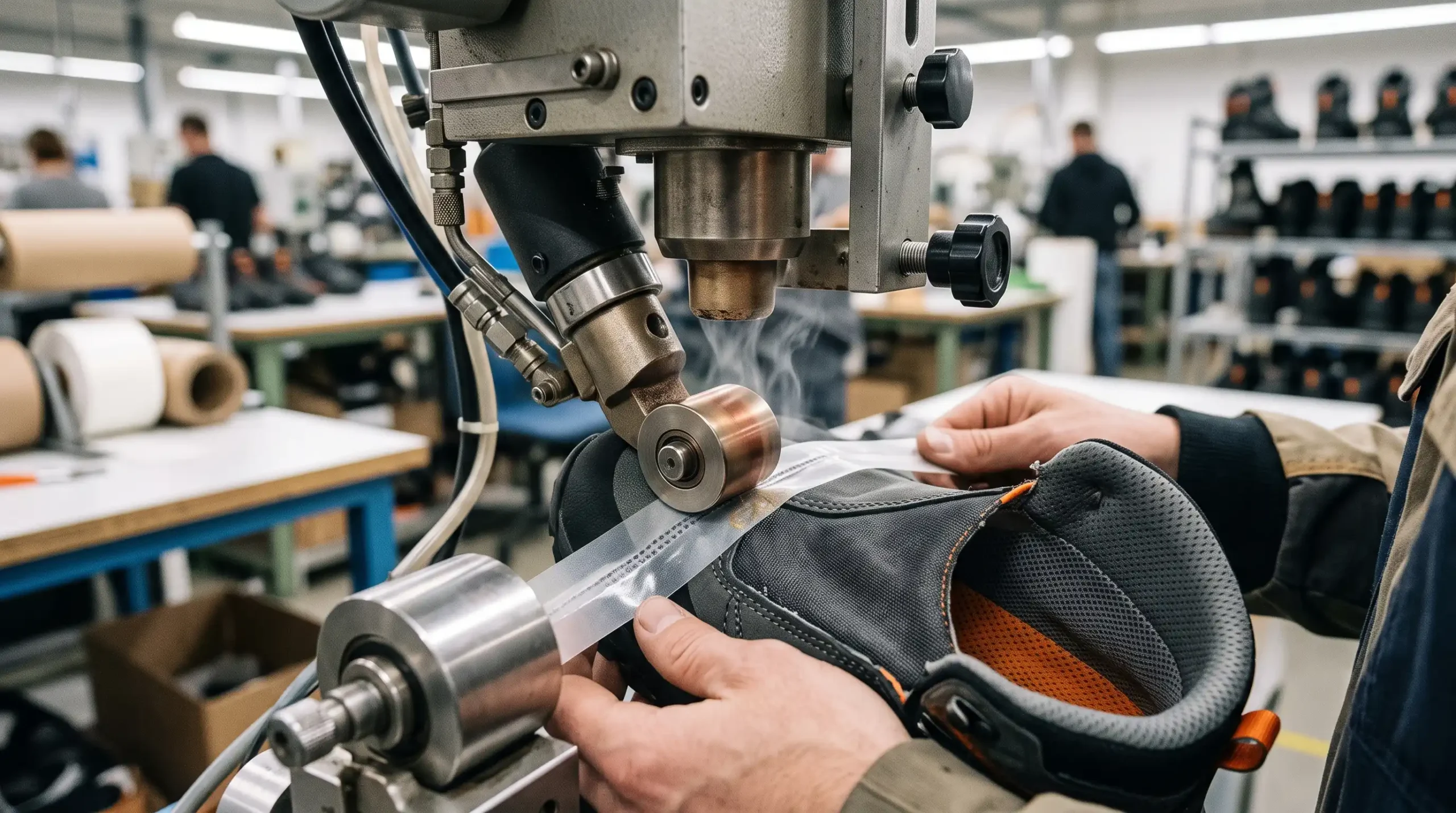
- Dyeing, finishing, or lamination, the core production step that consumes most of the calendar time.
- Quality control and packing, including physical testing and inspection of the finished roll goods.
Lead Time In The Fashion Industry
In the broader fashion industry, lead time has a wider meaning: the total span from design concept to finished goods reaching the shelf, which for apparel production commonly runs 8 to 14 weeks and can stretch to several months for full development cycles. The pressure to compress these timelines has reshaped the industry, and the movement toward fast fashion supply chains exists largely because shorter material and production lead times let brands respond to trends mid-season.
Shoe fabric lead times sit well below garment lead times because fabric is an upstream component rather than a finished product. A footwear factory that receives fabric in three weeks still needs to cut, stitch, and assemble the shoe, but the fabric itself is a single manufacturing step with no fit sampling or trim sourcing attached. This is also why material delays are so damaging: fabric is the first domino, and nothing downstream can start without roll goods on the cutting table.
Typical Lead Time Ranges And The Full Order Timeline
Plan on 7 to 10 days for in-stock shoe fabrics, 15 to 20 days for custom-dyed fabrics, 20 to 30 days for newly developed or laminated fabrics, and 10 to 15 days for reorders of already confirmed designs. Add three to six weeks for sea freight on top of the production window if goods ship from Asia.
| Order Type | Typical Lead Time |
| In-stock fabrics | 7 to 10 days |
| Custom-dyed standard fabrics | 15 to 20 days |
| Newly developed, laminated, or printed fabrics | 20 to 30 days |
| Reorders of confirmed designs | 10 to 15 days |
A realistic first order with a new supplier follows this sequence:
- Inquiry and quotation, covering fabric specifications, target price, and sample dispatch, usually completed within one week.
- Sample and lab dip approval, one to two weeks, during which color matching is confirmed before production starts.
- Deposit payment and production slot booking, which formally starts the lead time clock.
- Bulk production, sized according to the table above, whether the order is a custom shoes lining material or a standard outer construction.
- Final inspection, packing, and ex-factory handover, followed by sea or air transit to your warehouse.
Key Factors That Affect MOQ And Lead Time
The degree of customization is the single biggest driver of both MOQ and lead time, followed by factory capacity utilization, seasonal timing, and the number of sample approval rounds. Almost every strategy for reducing these numbers works by attacking one of these factors.
- Degree of customization. Stock fabrics, custom-dyed fabrics, and newly developed fabrics form a clear ladder, with each step up adding both minimum quantity and calendar time.
- Color matching rounds. Every additional lab dip or revised color standard adds days to the schedule. Approving a standard once and reusing it across seasons is one of the cheapest time savings available.
- Fabric construction and finishing. Coating, embossing, printing, and membrane lamination each add process steps, which lengthens production and raises the economic batch size.
- Order size and factory capacity. During peak season, even standard orders queue behind larger contracts, which extends quoted lead times without any change to the fabric itself.
- Holidays and peak season. Lunar New Year closures and the pre-holiday rush can add two to four weeks to Asian production schedules, so order timing matters as much as order size.
- Shipping method. Sea freight is economical but slow, while air freight recovers time at a much higher cost per kilogram, so the choice belongs in the plan rather than in last-minute emergencies.
How To Negotiate Lower MOQ And Shorter Lead Times
Buyers who prepare precise specifications, consolidate their color count, and stay flexible on construction routinely obtain lower minimums and faster delivery than buyers who simply ask for a discount. Choosing the right shoe fabric supplier for your order volume is the foundation, because a factory whose core business matches your order size has less reason to impose punishing minimums.
Practical levers that work in most negotiations:
- Choose stock-series fabrics in standard colors whenever the design allows, since these carry the lowest MOQs and the shortest lead times.
- Consolidate colors and designs so fewer lines need to hit the minimum individually.
- Ask about stock lots and overruns, which manufacturers often sell below normal MOQs simply to clear inventory.
- Book capacity before peak season and plan around Lunar New Year, since a factory with open slots is far more flexible than one running at full capacity.
- Pre-approve color standards and construction details to eliminate extra sampling rounds, which removes the most common source of delay.
- Split shipments when necessary, using air freight for a partial quantity to start shoe production while the balance follows by sea.
Planning Your Fabric Orders: A Practical Checklist
Work backward from your launch date. Add sea freight of three to six weeks, production of two to four weeks, sampling of one to two weeks, and a one week buffer, and most brands need to place fabric orders eight to twelve weeks before finished shoes must reach the warehouse.
A checklist keeps the plan honest:
- Fix the collection launch date first, then let every other date derive from it.
- Confirm the MOQ per color early, and align your color count with realistic sales forecasts rather than design ambition alone.
- Get the lead time quote in writing, and confirm whether it is ex-factory or door-to-door.
- Build a buffer of one to two weeks into the fabric stage, because material delays are the hardest to recover downstream.
- Confirm reorder lead times for carryover styles, since reorders of bestsellers run noticeably faster than first orders.
- Verify certifications and testing requirements before production starts, so final inspection does not become a source of delay.
Most established shoes fabric manufacturers publish their MOQ and lead time policies for standard products, and a supplier that states them clearly, explains what drives them, and responds to realistic constraints with concrete options is usually one that will deliver on schedule.
Frequently Asked Questions
Can I order below the MOQ for samples or a trial production run?
Yes. Sample orders sit outside normal MOQs: most manufacturers provide small swatches free of charge and sell meterage samples of one to five meters for testing. For a genuine trial run, some factories accept orders below the standard minimum with a surcharge, and others sell stock lots at reduced minimums, so it is always worth asking about overruns and surplus inventory.
Do quoted lead times include shipping time?
Usually not. Most lead time quotes in the shoe fabric industry are ex-factory, meaning they cover the period from deposit payment to goods leaving the factory. Transit is added separately: air freight takes four to seven days depending on destination, while sea freight takes three to six weeks. Always confirm which basis a quotation uses before building your production calendar.
What payment terms usually accompany MOQ-based fabric orders?
The most common structure is a 30 percent deposit by bank transfer with the 70 percent balance paid against a copy of the bill of lading. Letters of credit are used for larger programs with established suppliers. Because the lead time clock starts at deposit, delays in arranging the opening payment translate directly into delays in delivery.