Footwear buyers now ask for feedstock documents, restricted-substance reports, and an end-of-life plan at the sampling stage, not weeks after the order lands. EU rules on unsold stock have made material choice a compliance question too. For anyone specifying an upper, a lining, or a membrane, the practical question is narrower than the marketing suggests: which materials can run in production this season, at a cost the buyer accepts, with paperwork that survives an audit?
Sustainable material for shoes is any material that meets three conditions at once: feedstock from renewable, recycled, or waste streams; processing that keeps energy, water, and chemistry use low; and performance that keeps the shoe in use long enough to justify the resources already spent on it. The category covers recycled polyester and recycled nylon uppers, bio-based polyurethane, organic cotton, hemp, linen, wool, natural rubber, cork, chrome-free and vegetable-tanned leather, and plant-derived alternatives such as mycelium, cactus, apple pomace, and pineapple leaf fiber.
This guide covers the criteria, the material types, how each maps to a shoe component, and the benefits a buyer can verify.
What makes a shoe material sustainable?
Three filters decide it: where the feedstock comes from, how much energy, water, and chemistry the processing needs, and what happens to the shoe once the wearer is finished with it. Sourcing alone, recycled or plant-based, does not settle the question.
Feedstock and sourcing
Ask where the material stream comes from and whether it traces to a documented source. Textile Exchange reports global fiber production reached 132 million tonnes in 2024, up from 125 million tonnes in 2023, with recycled fibers holding a 7.6 percent share of that total (Textile Exchange, Materials Market Report 2025, published September 2025). Less than 1 percent of that volume came from pre- or post-consumer textiles, so a supplier who says recycled without naming the stream has said very little.
Processing footprint
Dyeing, coating, and lamination carry most of a material’s energy and chemistry load, so the useful comparison is process against process: continuous dyeing instead of batch, water-based or solvent-free lamination instead of solvent-based, and PFC-free repellency instead of fluorochemical finishing. Two mills can supply the same nominal fabric with very different footprints.
Durability and end of life
Longevity is the most reliable filter a buyer has. A material that holds its shape and abrasion class across a full season reduces impact more than a lighter-footprint option that fails early, since a failed pair wastes everything it already consumed. Buyers then ask whether a repair keeps the shoe in use and whether the components come apart for recycling.
Types of sustainable material for shoes
The options fall into four families: recycled and bio-based synthetics, natural fibers, natural rubber and cork, and leather alternatives. Each solves a different production problem and carries its own limitation, so the constraint belongs in the costing conversation.
| Material family | Examples | Typical shoe component | Main benefit | Main limitation |
|---|---|---|---|---|
| Recycled synthetics | Recycled polyester, recycled nylon, recycled EVA | Uppers, linings, laces, midsoles | Diverts waste, cuts virgin polymer demand | Fossil-derived chemistry and bonding blocks recovery |
| Bio-based synthetics | Bio-based TPU and PU, sugarcane and castor polyols | Membranes, coatings, midsoles | Renewable carbon on existing equipment | Feedstock competes with food and packaging supply |
| Natural fibers | Organic cotton, hemp, linen, wool | Uppers, linings, canvas | Renewable, breathable, biodegradable | Absorbs water, abrades faster, usually needs a blend |
| Natural rubber and cork | Plantation rubber, cork oak bark | Outsoles, footbeds | Renewable, provides grip and support | Most rubber compounds blend grades; cork needs protection from soaking |
| Leather alternatives | Mycelium, cactus, apple pomace, pineapple leaf fiber, chrome-free, and vegetable-tanned leather | Uppers, trims | Avoids chrome tanning or animal hide | Binder and backing decide the end-of-life outcome. |
Recycled and bio-based synthetics
Recycled polyester and recycled nylon are the most production-proven options. Both fit existing knitting, weaving, and lamination lines, so they appear in uppers, linings, and laces without forcing a process change. Bio-based TPU and PU have moved further than many buyers expect, and mills now use sugarcane and castor polyols in membrane and midsole formulations. One limitation is unavoidable: once a recycled upper joins a foam and a membrane, the layers stop coming apart, and recovering the polyester becomes difficult. Woven fabrics such as Oxford fabric upper stay the workhorse for structured and outdoor styles, where the gain comes from the yarn and the finish rather than the weave.
Natural fibers
Organic cotton, hemp, and linen suit warm-weather and casual constructions where breathability leads the brief. Hemp has the highest abrasion resistance of the three and grows on minimal water, linen wicks well and softens with wear, and wool regulates temperature and handles odor without chemical treatment. All three usually need a blend to meet a performance abrasion requirement, and cotton loses structure under daily use.
Natural rubber and cork
Natural rubber outsoles deliver traction while cutting the petroleum content of the shoe’s heaviest component. Most commercial compounds blend synthetic and natural grades, and blending often improves wear life, so ask whether the outsole meets the required abrasion class and whether the supplier will disclose the blend ratio. Cork belongs in footbeds rather than uppers, since it molds to the foot but needs protection from constant soaking.
Leather alternatives and lower-impact leather
Plant-derived alternatives draw on agricultural waste: mycelium from mushroom root structure, cactus pads, apple pomace, and pineapple leaf fiber. Each has a different hand feel and supply position, and most rely on a binder and a backing layer that decide how the material behaves at the end of life. That combination, not the plant name, is what a buyer should test. In conventional leather, chrome-free tanning removes the chromium(VI) risk that comes with skin contact, and vegetable tanning uses plant tannins.
How sustainable materials map to shoe components
A material only delivers its benefit in the right component. A recycled upper over a virgin midsole and a petroleum-based membrane moves a fraction of the total footprint, and a performance mismatch costs more than the material saves.
Uppers
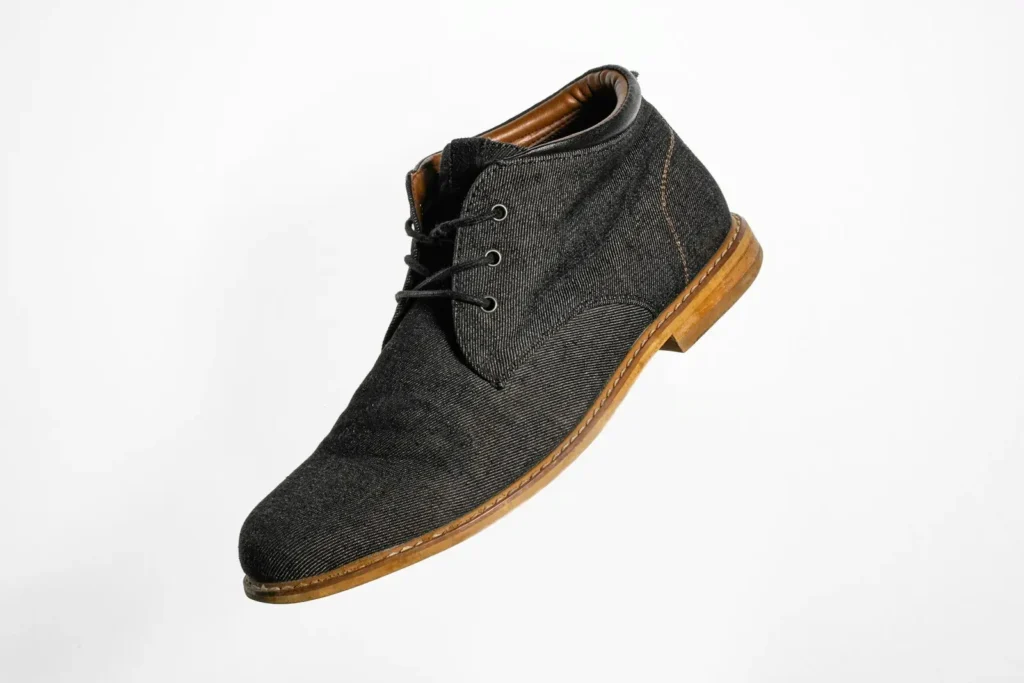
Uppers carry most of the visible area and most of the marketing weight. Knitted mesh offers breathability at a low material yield per pair, while woven constructions such as Oxford, ripstop, and canvas take coatings and laminates better and hold structure longer. Recycled yarns work in both, but the abrasion class depends on weave density and finish rather than fiber origin. The available range of shoe upper material spans recycled-content knits and wovens alongside conventional constructions.
Linings
The lining touches skin for the whole life of the shoe, so its chemistry and moisture behavior matter more than its recycled content. Recycled knit linings perform close to conventional ones, though yarn quality decides whether the surface pills. Natural fiber linings breathe well but hold moisture against the foot.
Waterproof membranes
Waterproofing is where the trade-off is sharpest, because the membrane and the lamination process pull in opposite directions. Fluorochemical repellents perform strongly but are under regulatory pressure, while PFC-free alternatives need tighter process control to reach the same rating. TPU membranes bond well with solvent-free adhesives; PTFE membranes offer high durability and breathability but sit at the opposite end of the recycling question. A TPU waterproof membrane is the usual starting point when the brief prioritizes lower process emissions.
Midsoles, outsoles, and bonding
Midsoles absorb most of a shoe’s volume, so a bio-based or recycled-content foam here moves more material than any upper decision. Bonding is the layer buyers overlook: solvent-based cements add volatile organic compound emissions and can prevent separation at the end of life. If a shoe does not come apart, the materials inside it go to waste.

What are the benefits of sustainable shoe materials?
The benefits split into three groups: a lower environmental load at the material stage, equal or better performance where the material matches the component, and commercial advantage when the buyer asks for documentation.
Environmental benefits
Recycled and renewable inputs reduce demand for virgin fossil feedstock, and lower-impact processing cuts energy, water, and chemistry use at the mill. The larger benefit comes from keeping stock in use. European brands and retailers destroy an estimated 4 to 9 percent of unsold textiles before anyone wears them, which produces around 5.6 million tonnes of carbon dioxide emissions, and the ESPR ban on destroying unsold footwear applies to large companies from 19 July 2026.
Performance and durability benefits
Where the match is right, sustainable materials meet the same specifications as conventional ones: recycled yarns hold tensile strength, bio-based foams hold compression set, and natural rubber holds grip. Durability also has a measurable environmental dimension at the wear surface. A controlled trail running study found that abrasive wear to outsoles released an average of 0.3 to 0.9 microplastic particles per linear meter per runner.
Commercial benefits
Material documentation now travels with the order. Retail buyers and EU importers ask for certification scope certificates, restricted-substance reports at the component level, and increasingly for data in the shape a digital product passport will require. A supplier who can hand over that file shortens the qualification cycle.
What is the healthiest material for shoes?
Health comes down to the layers in contact with skin and the chemistry that remains in them, not to whether the upper uses recycled content. Linings, insoles, and finishing chemicals are the deciding factors, and breathability matters more to foot comfort than the fiber story on the label.
Skin contact and finishing chemistry
Buyers handle this through the specification rather than through material marketing: azo colorant screening, chromium(VI) limits for leather, pH and formaldehyde limits for textile components, and test reports from the finishing mill for every layer that touches the foot. Chrome-free and vegetable-tanned leathers lower the risk profile of an insole, and natural fiber shoe lining material avoids the plasticizer questions that come with low-grade PVC and heavily plasticized PU. Limits differ by market, so the test protocol should match the destination.
Breathability and moisture control
A breathable upper over a non-breathable lining traps moisture, and trapped moisture drives odor, blistering, and material breakdown. The lining does the real work: a knit or natural fiber layer moves moisture away from the foot, a waterproof membrane lets vapor pass while blocking liquid water, and an insole that absorbs and releases moisture keeps the interior stable.
What are the most eco-friendly shoes?
The most eco-friendly shoes are the ones that stay in use the longest. A worn pair beats a theoretically greener pair that the buyer replaces every season, so the strongest builds are durable, repairable, and mostly mono-material, with recycled or renewable content concentrated in the components that carry the most mass.
Component-level comparison
A practical way to read a build is to compare each layer against its higher-impact default. The table describes design choices rather than measured results, and the value of each swap depends on how much material that layer contains.
| Component | Higher-impact default | Lower-impact alternative | What it changes |
|---|---|---|---|
| Upper | Virgin polyester mesh, solvent coating | Recycled yarn upper, PFC-free finish | Feedstock, finishing chemistry |
| Lining | Low-grade plasticized PU | Recycled knit or natural fiber lining | Skin contact, moisture management |
| Membrane | Fluorochemical membrane, solvent lamination | PFC-free membrane, water-based lamination | Process emissions, worker exposure |
| Midsole | Virgin EVA foam | Bio-based or recycled-content foam | Renewable carbon, waste diversion |
| Outsole | Styrene-butadiene-heavy rubber | Natural rubber at a matched abrasion class | Wear rate, microplastic shedding |
| Assembly | Cemented and glued throughout | Stitched or separable construction | Repair and recycling feasibility |
The membrane layer is where the trade-off shows up first, which is why shoe membrane selection now starts with the lamination process rather than the material specification alone.
How to verify a claim
Certification is the shortest route to a documentable claim, as long as the scope covers the material in question. The Global Recycled Standard and the Recycled Claim Standard cover recycled content and chain of custody, the Global Organic Textile Standard covers organic fiber and processing chemistry, and FSC and PEFC cover wood-based fibers. For leather, Leather Working Group audits cover tanneries, while OEKO-TEX testing covers restricted substances in the finished article.
FAQ
Is vegan material always more sustainable than leather?
No. “Vegan” means only that no animal-derived content is present, and a PVC-based vegan leather is petroleum-derived and difficult to recycle. The comparison that holds up is between constructions: a plant-derived alternative with a bio-based binder and a separable backing can outperform a conventionally tanned hide, while a heavily plasticized PU version does not.
Does switching to sustainable materials raise the cost per pair?
There is no standard premium, because cost depends on volume, certification scope, component count, and the mill’s process capability. Two steps reduce the uncertainty: ask for landed cost per pair rather than per meter, since material yield and lamination losses differ between constructions, and ask for the differential between the conventional and the lower-impact version of the same fabric.
Are sustainable shoe materials as durable as conventional ones?
In most components, yes, provided the material matches the use case. Recycled polyester and nylon retain tensile and abrasion performance close to their virgin equivalents, buyers specify bio-based foams by compression set rather than feedstock, and natural rubber outsoles reach the same abrasion classes as synthetic compounds. Failures come from mismatch: a breathable knit on a high-abrasion hiking brief, or a cork footbed in a shoe that stays wet.
Sustainable material for shoes is a specification decision rather than a label, and it holds up only when the feedstock, the process, and the wear life line up in the same component. Buyers who start with the component list, the abrasion class, and the destination market usually reach a workable specification faster than those who start with a material name.