Footwear has undergone a quiet revolution over the past two decades. Consumers now expect shoes that feel almost weightless during a morning run, a full shift at work, or a long day of travel, while footwear brands face mounting pressure to cut grams from every layer of the shoe without sacrificing cushioning, support, or durability. Behind this shift is a rapidly evolving toolbox of foams, textiles, and composites, and for brands, developers, and sourcing teams, knowing which materials deliver genuine lightweight performance has become a core competitive skill rather than a technical footnote.
Lightweight material for shoes refers to any fabric, foam, or composite engineered to reduce the overall weight of footwear while preserving cushioning, support, durability, and breathability. The most widely used options include EVA, PU, and ETPU foams in midsoles; mesh, knit, and microfiber textiles in uppers; and TPU, lightweight rubber compounds, cork, and carbon fiber composites in outsoles and structural parts. The right choice always depends on the shoe category, the intended activity, and the balance between weight, cost, and durability.
The sections below explain how lightweight footwear is defined, why material weight matters so much, which materials dominate each part of the shoe, and how these materials are applied across different footwear categories.
What Is Considered a Lightweight Shoe?
A lightweight shoe is one that falls at or below the average weight for its category, typically under 200 grams per shoe for racing and performance running footwear, roughly 200 to 300 grams for casual sneakers, and around 450 grams or less for hiking and work styles. Because structural demands differ so much between categories, lightweight is always a relative benchmark rather than a single universal number.
Weight expectations vary sharply by shoe type, so it helps to look at realistic reference ranges before evaluating any construction:
| Footwear Category | Lightweight Range (per shoe) | Traditional Average |
| Racing and performance running | Under 200 g | 240 to 280 g |
| Everyday running and training | 200 to 280 g | 300 to 350 g |
| Casual sneakers and walking shoes | 200 to 300 g | 350 to 450 g |
| Hiking shoes and boots | 300 to 450 g | 550 to 850 g |
| Work boots | 400 to 600 g | 700 to 1000 g |
The weight of a finished shoe is concentrated in a handful of components: the upper, the midsole, the outsole, the lining, and the reinforcing parts such as heel counters and toe caps. In many athletic styles, the midsole alone can account for a large share of total weight, which is why foam selection is usually the first decision in a lightweighting program. The upper comes next, followed by the outsole. Modern advances in lightweight material for shoes allow designers to reduce mass layer by layer instead of simply deleting cushioning and support, which was the old and flawed approach to making shoes lighter.
Why Material Weight Matters in Footwear Design
Material weight has a direct and measurable effect on the energy a wearer spends with every step. Research frequently cited in the running community estimates that every 100 grams of added shoe weight raises the energy cost of locomotion by roughly 1 percent, so heavier shoes translate into faster fatigue, greater joint loading, and lower endurance across the thousands of steps a person takes each day.
That 1 percent figure compounds quickly in real life. A moderately active person may take five thousand or more steps per foot every day, and each of those steps involves lifting the full mass of the shoe. Over a week, a month, or a season, the difference between a 280 gram shoe and a 380 gram shoe adds up to a substantial amount of extra work for the muscles and joints of the lower body. This is why lighter constructions are associated with several practical benefits:
- Reduced fatigue in the feet, calves, and hips during long periods of standing or walking
- Lower cumulative strain on the ankles, knees, and hips
- Better breathability and temperature control, since most lightweight uppers are open textiles rather than dense leathers
- Quicker acceleration and more natural foot motion in athletic activities
- Improved comfort for travelers, healthcare workers, and anyone on their feet all day
There is, however, an important caveat: lightweight should never mean flimsy. A well-engineered light shoe keeps its arch support, shock absorption, and structural integrity, and simply removes dead weight. The materials discussed below are valuable precisely because they allow this distinction.
Types of Lightweight Materials for Shoes
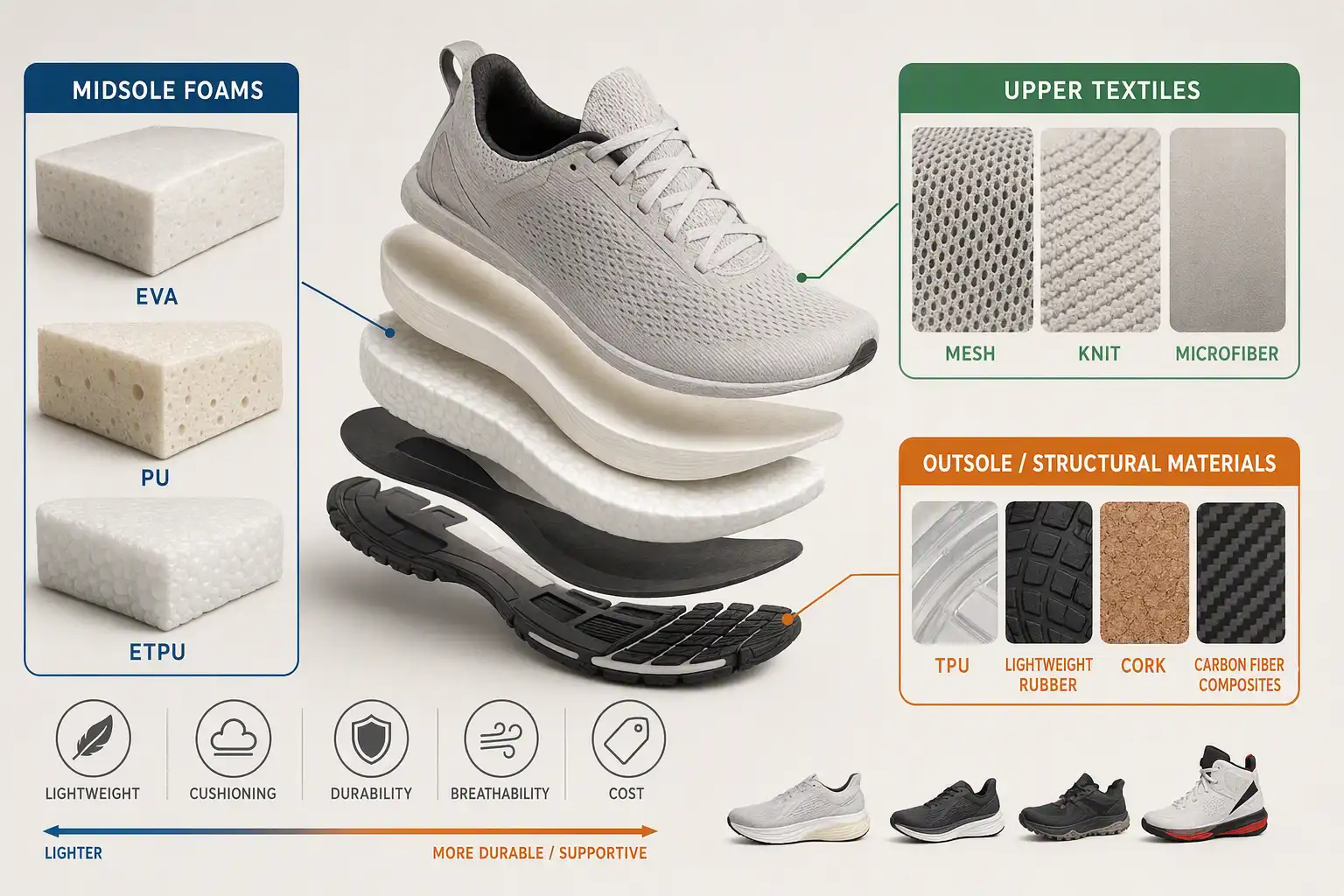
The main types of lightweight shoe materials are midsole foams such as EVA, PU, and ETPU; upper textiles such as mesh, knit, and microfiber; and outsole or structural materials such as TPU, lightweight rubber, cork, and carbon fiber composites. Each material family trades weight against cushioning, durability, breathability, and cost, and most modern shoes combine several of them in a single construction.
Midsole Foam Materials
The midsole is the cushioning layer between the upper and the outsole, and it is where lightweight material science has advanced fastest.
- EVA foam. Ethylene-vinyl acetate is an expanded copolymer foam and the workhorse of modern midsoles. It is light, flexible, easy to compression mold, and its density can be tuned across a wide range, which lets engineers dial in different levels of softness and support within the same shoe. Its main limitation is that it gradually compresses and loses rebound over long use. For a full technical profile of the polymer, see the reference on ethylene-vinyl acetate.
- PU foam. Polyurethane is denser than EVA but considerably more durable and dimensionally stable. It holds its cushioning properties far longer, which makes it a favorite for work footwear and comfort shoes where longevity matters more than saving the last few grams.
- ETPU. Expanded thermoplastic polyurethane consists of thousands of fused elastic beads. It is light, highly resilient, and resists compression set much better than standard EVA, which is why it appears in performance midsoles that demand both bounce and durability.
- Pebax. Polyether block amide foams and plates sit at the premium end of the spectrum. They are extremely light, offer elite energy return, and stay stable across a wide temperature range, but the material cost limits their use to high-end performance products.
Upper Materials
The upper wraps the foot, and its material choice strongly influences both weight and climate comfort. Selecting the right shoes upper material is one of the most consequential decisions in any lightweight design, because the upper contributes a large share of total shoe mass in traditional constructions.
- Mesh fabrics. Engineered mesh is an open, net-like textile that combines minimal weight with maximum airflow. Modern designs vary knit density zone by zone, providing structure where support is needed and openness where ventilation matters. Laminated constructions such as three-layer mesh fabric bond a face mesh with a functional membrane and a backing textile, adding weather protection or moisture management while keeping the composite thin and light.
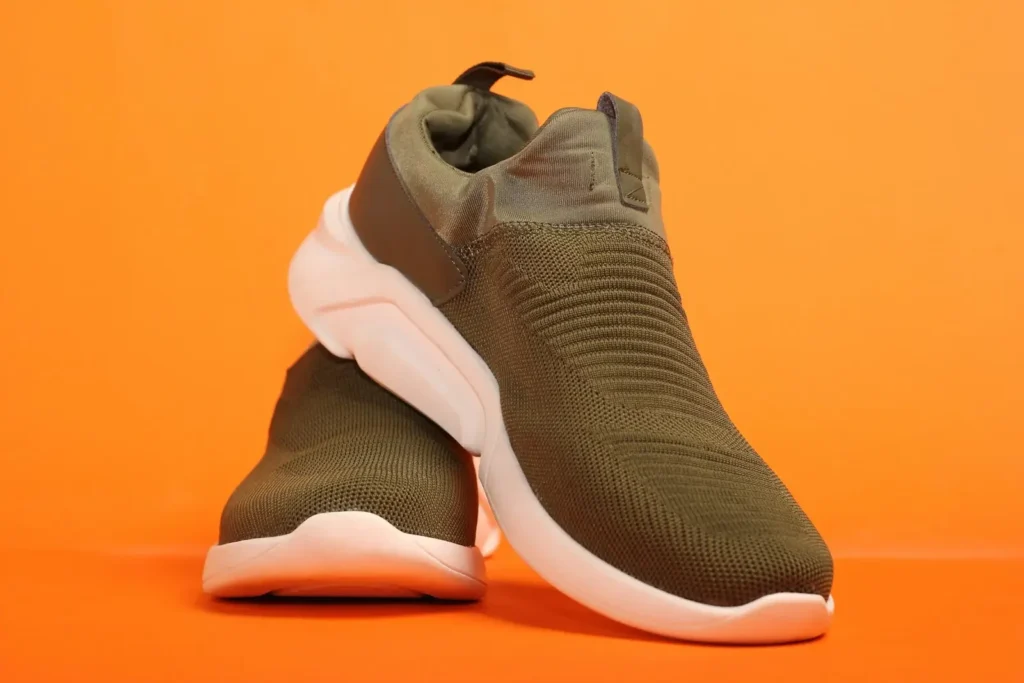
- Knit textiles. Knitted uppers are produced as a near-seamless single piece, which removes overlapping panels, adhesives, and stitching. The result is a sock-like fit, flexible stretch, and very low weight, along with reduced cutting waste during production.
- Microfiber and synthetic leather. These offer the look and structure of leather at a fraction of the weight, plus easier care and consistent supply. They are widely used in casual, fashion, and value-focused footwear where a premium surface appearance is required.
Outsole and Structural Materials
Outsoles must resist abrasion and provide traction, so they are the hardest place to save weight, but several materials make it possible.
- Lightweight rubber and TPR. Blown rubber compounds incorporate air during forming, cutting weight while retaining reasonable grip. Thermoplastic rubber is lighter and more flexible than conventional rubber and molds easily into varied tread patterns.
- TPU. Thermoplastic polyurethane provides an outstanding balance of low weight, abrasion resistance, and structural rigidity. It appears in outsoles, protective overlays, heel counters, and support plates. Its chemistry and properties are summarized in the overview of thermoplastic polyurethane.
- Carbon fiber composites. Carbon fiber offers an exceptional strength-to-weight ratio, allowing stiff, propulsion-oriented plates that weigh a fraction of equivalent plastic parts. Cost keeps it confined mostly to racing and premium performance footwear; the material class is covered in detail in this carbon fibers reference.
- Cork. Agglomerated cork is a natural, renewable, and breathable option used in footbeds and midsole components. It is light, cushions well, and gradually molds to the shape of the foot, making it popular in comfort footwear and sustainable collections.
The table below compares the most important options at a glance:
| Material | Typical Location | Weight Level | Key Properties | Best Suited For |
| EVA foam | Midsole | Very light | Tunable cushioning, low cost | Running, casual, comfort |
| PU foam | Midsole, footbed | Light | Durable, stable support | Work, comfort footwear |
| ETPU | Midsole | Light | High rebound, resists packing out | Performance athletic |
| Pebax | Midsole, plates | Ultra light | Elite energy return | Premium performance |
| Mesh | Upper | Very light | Breathable, flexible | Athletic, casual |
| Knit | Upper | Very light | Seamless, sock-like fit | Sneakers, lifestyle |
| Microfiber | Upper | Light | Leather-like appearance | Fashion, casual |
| TPU | Outsole, overlays | Light to moderate | Abrasion resistance, structure | Sports, outdoor |
| Lightweight rubber, TPR | Outsole | Moderate | Grip, abrasion resistance | Everyday, casual |
| Cork | Footbed | Light | Natural, moisture control | Sandals, comfort |
| Carbon fiber | Plate | Ultra light | Stiffness, energy transfer | Racing, elite sport |
Applications of Lightweight Materials Across Footwear Categories
Lightweight materials are applied differently in each footwear category. Athletic shoes pair EVA or ETPU midsoles with mesh and knit uppers, casual and work styles combine PU footbeds with microfiber uppers and TPU or lightweight rubber bottoms, and outdoor performance designs blend durable TPU, composite plates, and reinforced mesh to survive rugged terrain at a manageable weight.
Athletic and Running Footwear
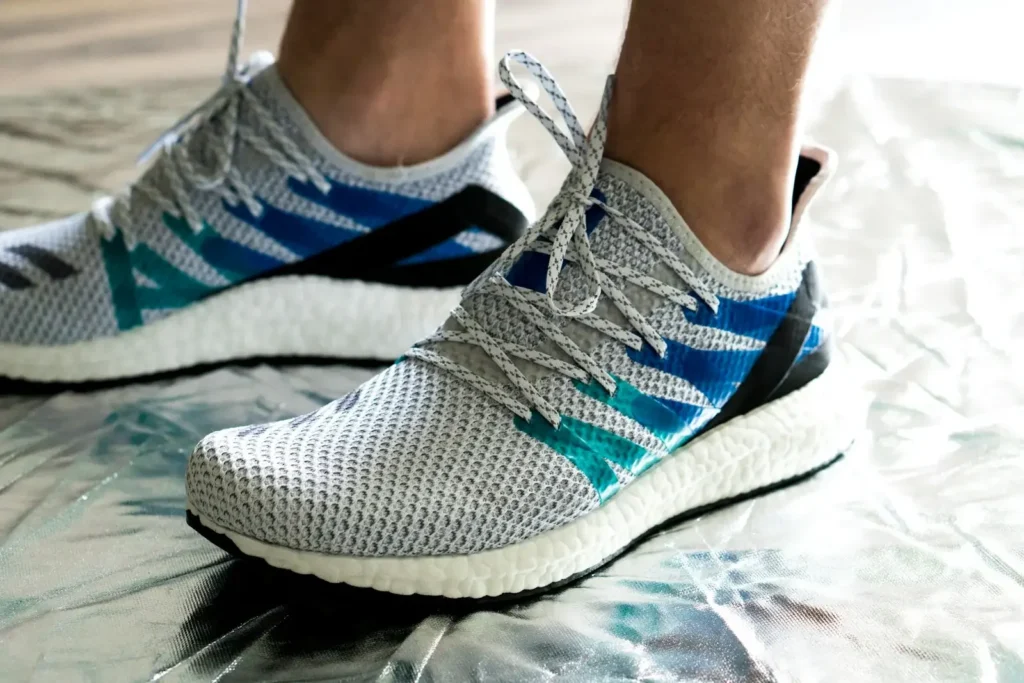
Running shoes, trainers, and court shoes push lightweighting furthest because every gram affects performance. A typical performance build uses an EVA or ETPU midsole, an engineered mesh or knit upper, and a rubber outsole thinned and segmented so grip exists only where the foot actually contacts the ground. Racing models go further with Pebax foams and carbon fiber plates to combine minimal mass with maximal energy return. The design goal is simple: remove weight from every layer while keeping the cushioning and support that protect the athlete over long distances.
Everyday, Casual, and Work Footwear
In casual sneakers, walking shoes, and occupational footwear, comfort over long hours replaces pure speed as the priority. These categories favor PU or EVA footbeds for durable cushioning, microfiber or mesh uppers for low weight and easy care, and TPU or lightweight rubber outsoles for slip resistance and abrasion life. Nurses, retail staff, and warehouse workers benefit most here, since shedding weight reduces end-of-day fatigue in jobs that involve standing and walking for eight or more hours. Lining choice also matters, and selecting the right shoes lining material helps manage moisture and keeps the interior light, breathable, and comfortable through long shifts.
Outdoor and Performance Footwear
Hiking boots, trail shoes, and other rugged styles face the hardest trade-off between protection and weight. Modern builds use reinforced mesh or ripstop uppers instead of full-grain leather wherever abrasion risk allows, EVA or ETPU midsoles for cushioning over long descents, and TPU plates or toe caps for underfoot protection. Carbon fiber and composite shanks deliver torsional stability at a fraction of the weight of steel. A contemporary lightweight hiker can weigh close to a pound per shoe while still providing the support once found only in much heavier boots.
How to Choose the Right Lightweight Material
There is no single best lightweight material for every shoe. The right choice depends on the target activity, required durability, climate, budget, and sustainability goals, and the strongest designs treat the shoe as a system, pairing a light midsole with an equally light upper and outsole so that no single layer cancels out the savings achieved in another.
A practical selection process looks like this:
- Define the end use and set a weight target per shoe for the category.
- Balance weight against durability requirements, accepting slightly heavier PU or TPU where the product must survive hard use.
- Match upper breathability to the climate the wearer will face.
- Confirm that cushioning and support features remain intact, since weight saved by deleting structure produces a worse product, not a better one.
- Evaluate material cost and processing behavior at production volumes.
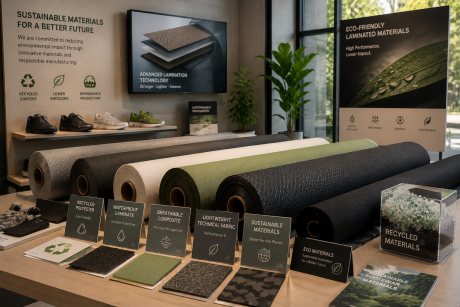
- Check sustainability requirements, such as recycled content or bio-based inputs.
Buyers should also stay alert to poorly executed lightweighting. Shoes that feel featherlight because the midsole bottoms out after a few weeks, mesh so thin it offers no midfoot structure, or laminated layers that peel apart after exposure to heat and moisture are all signs of weight removed at the expense of quality. For a deeper look at evaluating upper options, a dedicated shoe upper materials guide covers construction methods and performance testing in detail. Brands that need category-specific performance, such as waterproofing plus breathability in one composite, can also work with suppliers on custom lamination solutions rather than compromising with off-the-shelf fabrics.
Frequently Asked Questions
How much weight can lightweight materials actually save in a finished shoe?
Combining an EVA or ETPU midsole, an engineered mesh upper, and a segmented lightweight outsole typically reduces total shoe weight by 20 to 40 percent compared with traditional leather and solid rubber constructions of the same category. Exact savings depend on the shoe type, since heavy categories like work boots offer more grams to remove than racing flats.
Do lightweight materials cost more to source and manufacture?
Not uniformly. EVA foam, mesh, and TPR are cost neutral at scale and are often cheaper than leather alternatives. High performance options such as ETPU, Pebax, and carbon fiber carry a meaningful premium, but unit costs fall as volumes rise and as these technologies mature. The production saving from lighter shoes, including lower shipping costs per pair, frequently offsets part of the material premium.
Can lightweight shoe materials be recycled or made from sustainable sources?
Yes, to a growing extent. Recycled PET bottles are commonly spun into mesh uppers, bio-based EVA and TPU are entering commercial use, natural cork is inherently renewable, and recycled rubber compounds are increasingly available for outsoles. Foams remain the hardest component to recycle due to their mixed polymer structure, so brands pursuing circular design often prioritize mono-material construction and supplier take-back programs.