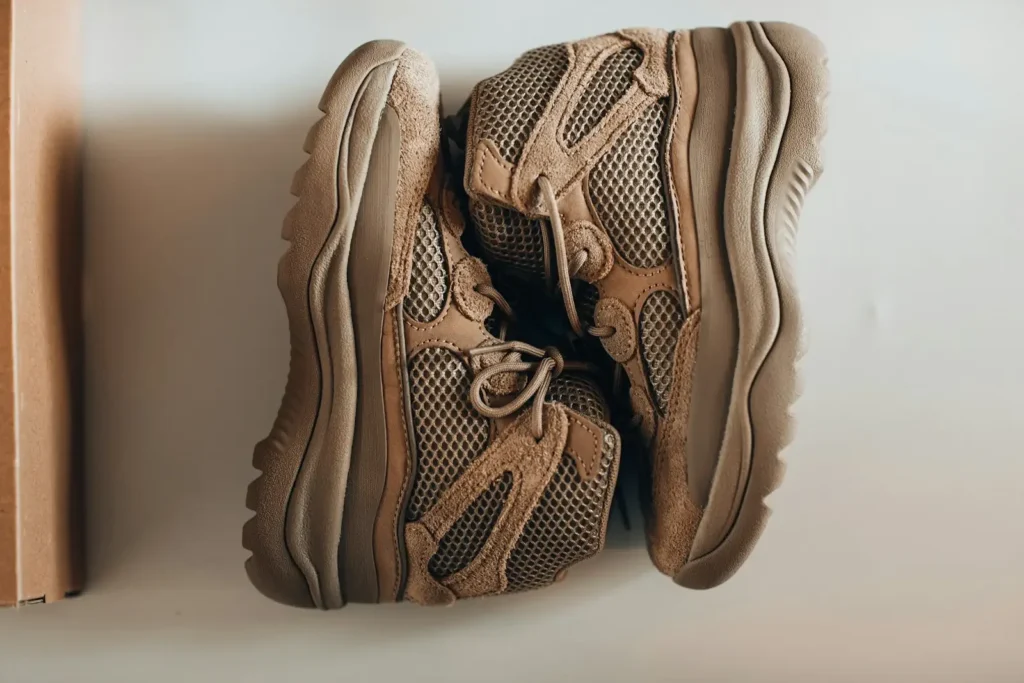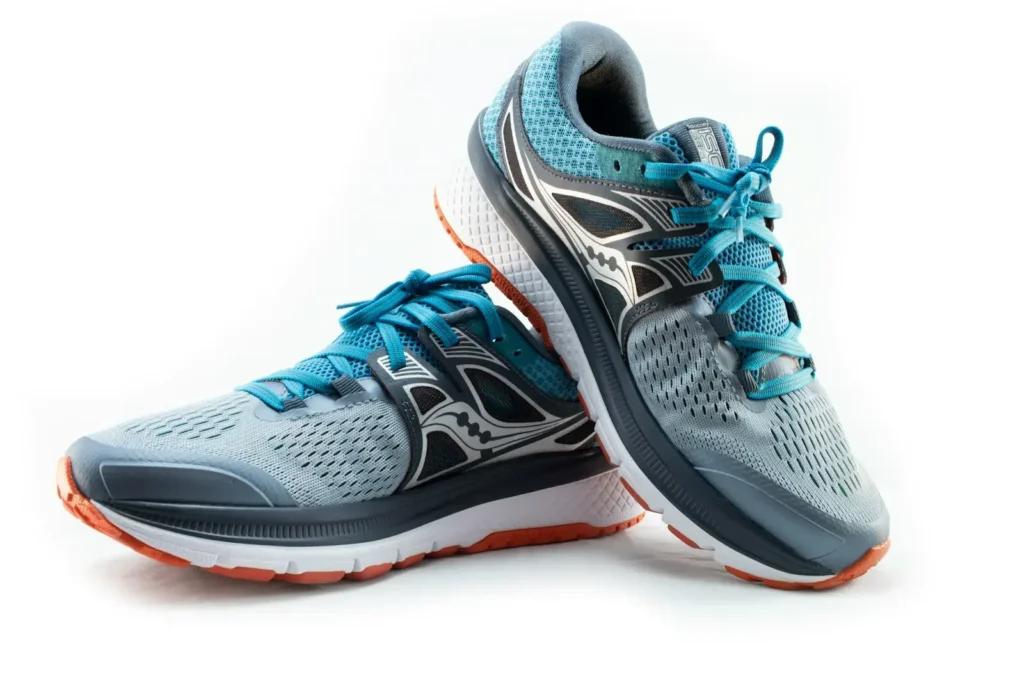
An athletic or casual shoe is judged in the first three seconds by the surface the buyer can see: the upper. That single component also sets breathability, how the foot is held, which decoration methods are available, and a large share of the bill of materials. Two shoes sharing the same midsole and outsole can feel like different products purely because one uses a shoe upper material built from open mesh and the other from a one-piece knit shell. For the product manager specifying a range, the choice rarely comes down to which looks more modern; it comes down to which construction survives the price point, the climate and the wear pattern the shoe is sold into.
The difference is structural. A mesh shoe upper is a woven or warp-knitted synthetic panel with perforated or low-density zones, cut from roll goods and assembled with separate reinforcement pieces; a knit shoe upper is yarn looped into a near one-piece, sock-like shell on a flat or circular machine, with stretch built into the fabric itself. Mesh delivers more airflow per unit of cost, holds its dimensions better and accepts detailed multi-colour graphics; knit delivers a seamless, adaptive fit and a premium surface at a higher unit cost and a longer development cycle.
The comparison below works through construction, breathability, fit, durability, water resistance, cost and selection logic in that order.
What Is a Mesh Shoe Upper?
A mesh shoe upper is a synthetic textile, nearly always polyester or nylon, produced with open perforations or engineered zones of different density, then cut and joined with reinforcement pieces around the eyestay, toe and heel.
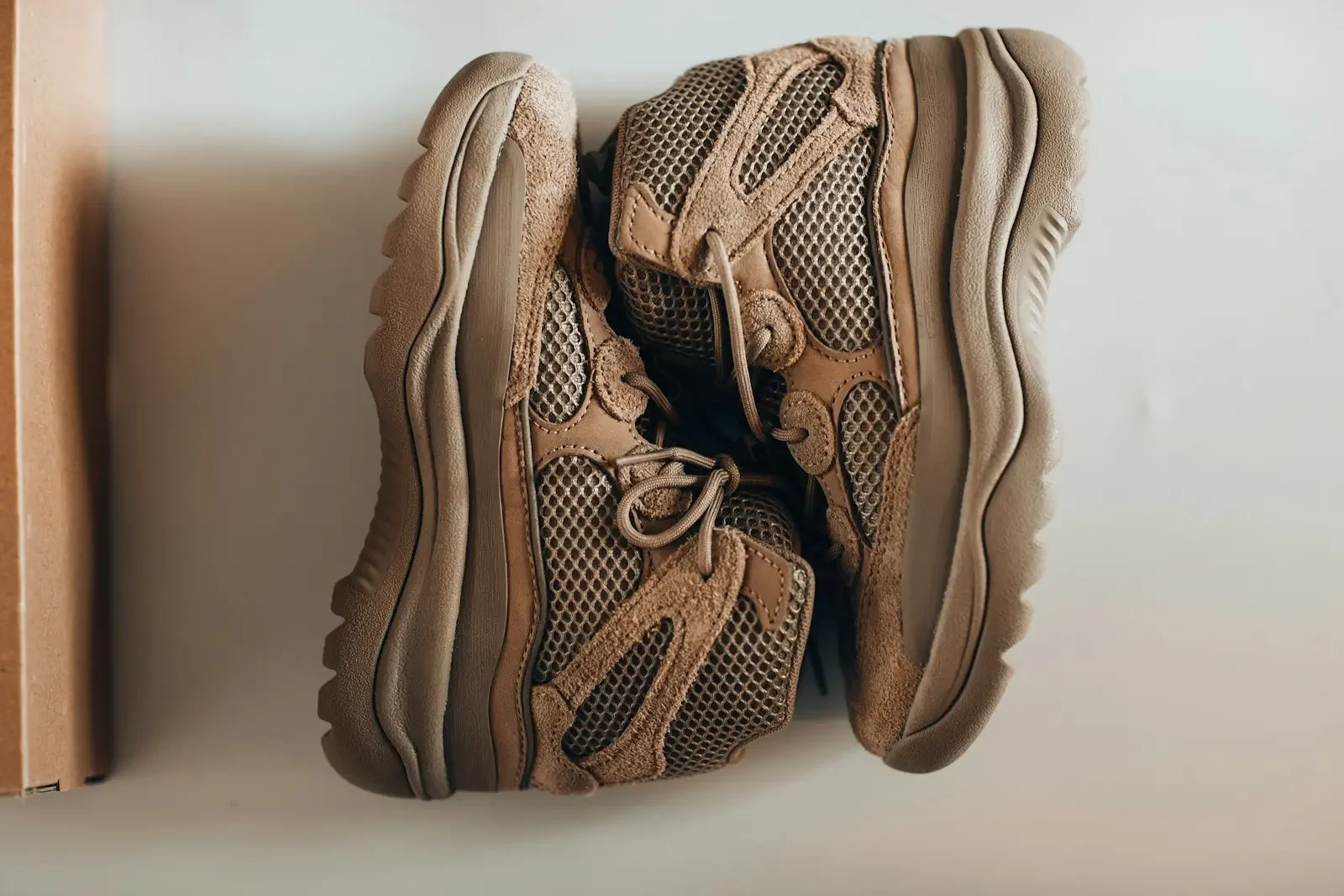
Mesh is a family of constructions rather than one fabric. Basic mesh is a uniform open weave used on value footwear. Engineered mesh varies density across the panel in a single knitting or weaving operation, so open area sits over the forefoot where heat builds and tighter structure sits over the midfoot where the foot needs containment. Buyers normally specify it by weight: light panels fall around 180 to 220 gsm, mid-weight training uppers around 240 to 280 gsm, and heavy-duty or work applications above 300 gsm. Higher weight buys abrasion resistance and shape retention at the cost of airflow, which is why the same nominal material can feel completely different in two shoes.
How Engineered Mesh Is Built
Most performance mesh is either a single open layer stabilised by hot-melt yarns, or a laminated stack in which a face mesh is bonded to a film and a backing. The laminated route is what makes a breathable upper weather-resistant: a three-layer mesh fabric combines outer mesh, functional film and inner backing in one roll, so the factory cuts one component instead of three and the bond quality is controlled upstream rather than at assembly.
Where Mesh Performs Best
Mesh suits high-volume programmes: entry and mid-tier running shoes, training shoes, court shoes, school and uniform footwear, and any style that depends on multi-colour graphics. It also suits hot-climate markets where airflow outranks weather protection.
What Is a Knit Shoe Upper?
A knit shoe upper is built by looping yarn into interlocking stitches, forming a shell that is close to one piece, carries stretch in the structure itself, and needs no seam allowance across the vamp.

Because the fabric is formed stitch by stitch, the engineer controls stretch, opacity and ventilation by changing stitch type and density rather than by cutting holes. A dense interlock zone over the midfoot gives containment while an open tuck-stitch zone over the toe gives ventilation, all in one panel. The looping structure also explains the material’s weakness: loops can slide against each other under sustained load, so an unreinforced knit relaxes and the shoe gradually fits larger. For a fuller explanation of how loop structures behave, see this reference on knitted fabric.
Flat Knitting and Circular Knitting
Flat machines produce a two-dimensional panel with fully formed edges, which allows shaped pieces, open zones and logos knitted in place, but requires a linking or sewing step to close the shoe. Circular machines produce a tube, usually for sock-style uppers with a single closable seam, and run faster per unit. Flat knitting gives more design control; circular knitting gives better throughput and lower labour content.
Where Knit Performs Best
Knit belongs on flagship running models, lifestyle sneakers and any product where the upper is part of the story. It also suits wider forefeet and higher insteps, because the stretch accommodates volume that a cut-and-sew mesh panel would press on.
Mesh vs. Knit: Side-by-Side Comparison
On the six factors that decide most programmes, mesh is the lower-cost, better-ventilated and more dimensionally stable option, while knit is the softer, more adaptive and more premium-looking one; neither is better in absolute terms, and the right answer follows the price point and the use case.
The table condenses the trade-offs that come up in every briefing.
| Factor | Mesh upper | Knit upper |
| Airflow | Open across the whole panel by default | Depends on stitch structure; open zones breathe, dense zones do not |
| Moisture and drying | Dries comparatively fast; water passes through easily | Holds more moisture; thicker structures dry slower |
| Structure and lockdown | Shape comes from pattern plus PU or TPU overlays | Shape comes from support yarns and a firm heel counter |
| Abrasion and wear | Predictable when reinforced at toe, eyestay and heel | Resists snagging but can relax and bag out |
| Weight | Light to very light | Light, similar range |
| Unit cost and development | Lower material cost, shorter development | Higher yarn and machine cost, longer programming |
The practical reading is that mesh is a specification you can write and repeat, while knit is a specification you have to develop.
Which Upper Is More Breathable?
Mesh is more breathable by default, because its open area is distributed across the entire panel; knit can match or exceed it only where the structure is deliberately opened, which costs strength and opacity in that same zone.
This is the most misunderstood point in the comparison. A coarse open mesh moves air freely over the whole vamp, including areas a buyer never inspects. A dense knit, often used to keep a clean premium surface, can trap more heat than a mid-weight mesh at the same thickness, because the stitch structure closes the gaps that airflow depends on. In controlled measurements of upper materials, ventilated mesh constructions kept the dorsum of the foot measurably cooler and less humid than tighter synthetic uppers over the same activity period, which is consistent with what foot microclimate research reports for open versus closed structures.
Three variables decide the real number, regardless of material family: the percentage of open area on the vamp, the film or backing behind it, and the sock and insole the shoe is worn with. A laminated mesh with a solid membrane blocks most vapour exchange, and a knit worn with a thick cotton sock behaves like a closed shoe.
How Do Fit, Structure and Durability Compare?
Knit fits by stretching and recovering around the foot, which gives immediate comfort and tolerance for irregular foot shapes; mesh fits by pattern geometry and reinforcement, which gives a more repeatable, more locked-in hold and better dimensional stability over the life of the shoe.
Stretch, Recovery and Lockdown
The comfort of knit comes from elastic recovery, and its durability problem comes from the same property. Under repeated loading, loop structures relax and the panel takes a permanent set, so a knit shoe that fits perfectly at first wear can feel roomy after a few months of daily use. This is manageable in production: denser stitch counts in the midfoot, elastane or high-tenacity support yarns laid in, and a firm heel counter all slow the relaxation. It cannot be eliminated. Mesh has the opposite profile, since it barely stretches, so fit comes from the last and the pattern while the panel keeps its shape for years.
The implication for buyers is concrete. Knit is the safer choice where complaints are dominated by width or instep pressure, and the riskier choice where a uniform, repeatable fit matters across thousands of pairs.
Reinforcement Strategies and Wear Points
Both materials need help at the same four locations, but the methods differ.
- Toe bumper: a welded film or stitched overlay on mesh, a denser stitch or hot-melt yarn on knit.
- Eyestay and lacing: PU film or a separate eyestay piece on mesh, laid-in support yarns on knit.
- Heel: an external counter or an internal heel clip on both.
- Flex zone: avoided on both, since a stiffener over the metatarsal flex line creates a crack initiation point.
Durability claims should be tied to a test rather than a description. Grab tensile strength, measured under ASTM D5034, and abrasion resistance under a rotary platform or flex test are the two numbers worth writing into a specification, because durable mesh and durable knit mean nothing without a method and a threshold attached.
Are Mesh and Knit Uppers Waterproof?
Neither is waterproof in its standard form. Both are open, air-permeable textiles that wet out and pass water, and any real water resistance comes from a film, a coating or a different upper family entirely.
A durable water-repellent finish slows wetting but does not resist hydrostatic pressure, and it washes out with use. A film laminated behind the upper is the only route to a genuinely waterproof shoe, and it usually changes the rest of the build: a shoe lining material that protects the film, sealed seams and a gusseted tongue.
Care follows the same logic. Mesh tolerates gentle machine washing and dries quickly. Knit absorbs more water, becomes heavy when wet and is best hand-cleaned, because agitation and heat disturb the stitch tension that gives the shoe its fit. Air drying away from direct heat matters for both, since heat degrades the adhesives bonding the upper to the midsole.
How Do Cost, Lead Time and Branding Differ?
Mesh is cheaper on both counts, in material and in development time, while knit carries a higher unit cost and a longer, more engineering-heavy cycle that only pays back at a price point able to support it.
The cost gap comes from four places:
- Yarn and machine time. Knit uppers consume programmed machine hours, and fine-gauge yarns cost more per kilogram than standard mesh yarns.
- Development. A knit upper needs pattern programming, stitch trials and tension checks before a wearable sample exists; a mesh upper can often be sourced from existing roll goods.
- Labour. Mesh needs cutting and stitching of multiple pieces plus overlay application; knit reduces piece count but adds linking or seam closing and a lasting step that is harder to automate.
- Yield. Knit panels are less forgiving of distortion during lasting, so rework and second-quality rates run higher until the process is stable.
Branding splits along the same line. Mesh is the better surface for detailed multi-colour graphics, screen print and heat transfer, because a flat, dimensionally stable panel holds registration. Knit is better for knitted-in logos and tonal effects and handles a limited palette cleanly; a four-colour gradient on knit usually forces the decoration to heat transfer anyway.
How Should You Choose an Upper for Your Range?
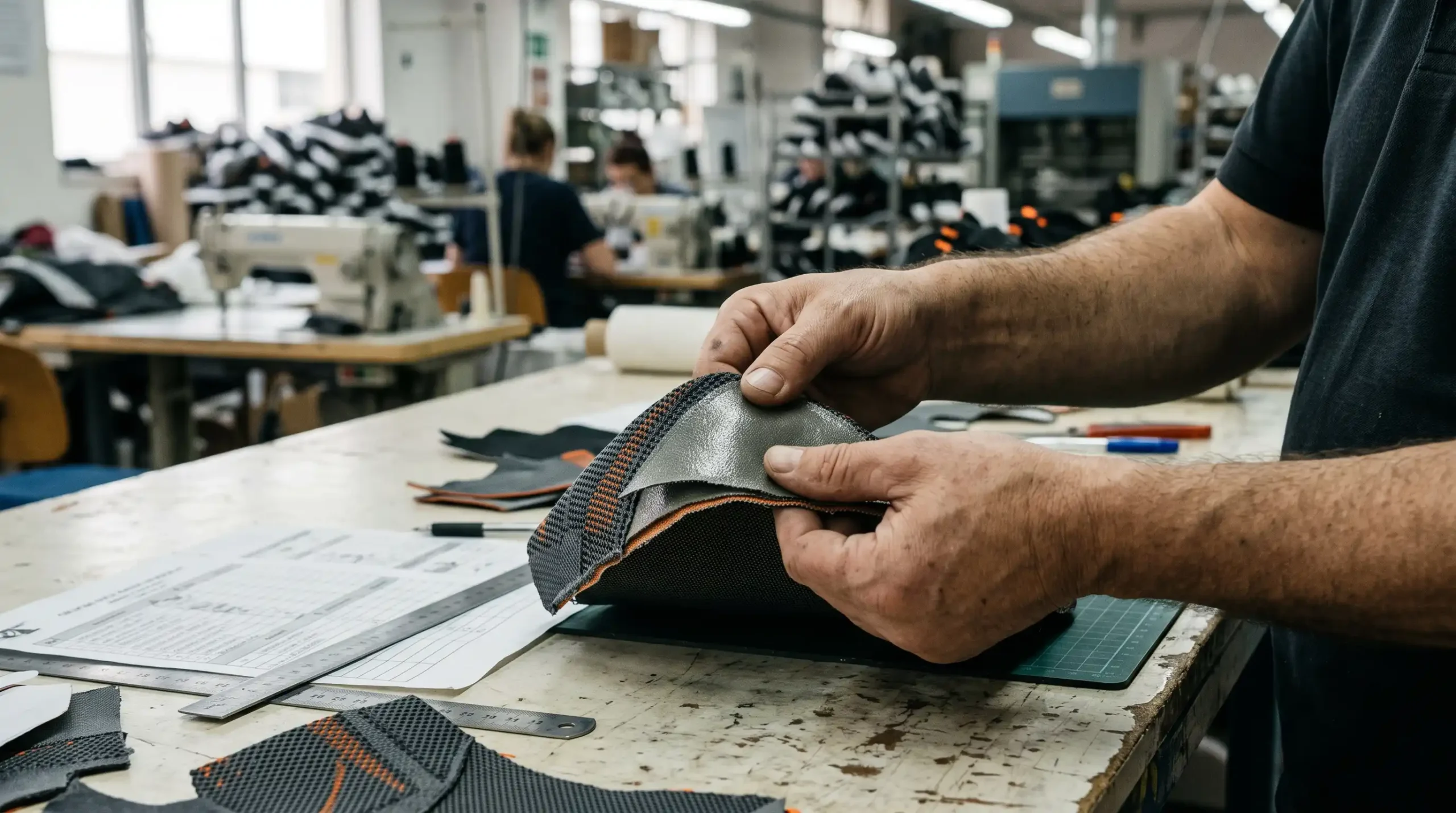
Start from the price point and the wear pattern, then let the upper follow: mesh for volume programmes that need airflow, graphics and predictable cost, knit for premium models where fit feel and surface quality justify the extra development.
| Product position | Recommended upper | Reason |
| Entry and mid running, training, court | Engineered mesh with overlay package | Lowest landed cost with reliable airflow and containment |
| Flagship running, lifestyle | Knit with midfoot and heel reinforcement | Seamless fit and premium read at a price that carries it |
| Hot-climate and uniform programmes | Lightweight open mesh | Breathability and dimensional stability across sizes |
| Wet-weather outdoor | Mesh or knit over a film | Only the membrane delivers waterproofing |
| Wide-fit and comfort lines | Knit or high-stretch mesh | Stretch accommodates volume without a new last |
Four errors account for most sampling revisions: specifying knit on a value budget, drawing mesh without overlays, assuming knit is automatically cooler, and locking the upper before the factory has given design-for-manufacture feedback. The wider selection criteria, including lining and reinforcement pairing, are covered in this shoe upper materials guide.
FAQ
Three questions come up once the construction decision is settled.
Can a single shoe use both a mesh and a knit upper?
Yes, and it is common on mid-tier running shoes: knit around the collar and midfoot for fit, mesh over the forefoot for ventilation, joined by a stitch line or a bonded seam. The approach adds one assembly step and requires the two panels to be matched for stretch and colour fastness, but it lets a model hit a breathability target without paying for a fully engineered knit.
Which upper holds up better in school or uniform footwear?
Mesh, in most cases. Uniform programmes need consistent sizing across large orders, resistance to scuffing and washing, and low cost per pair. A mid-weight mesh with a reinforced toe and a firm counter meets all three. Knit is viable only when the brand position demands it and the buyer accepts a shorter shape-retention life.
Does the upper change the last or the size grading?
It can. Knit uppers usually need a slightly tighter last to compensate for stretch, and their tolerance for volume means one width can cover a wider band of feet. Mesh is less forgiving, so a mesh programme often needs two widths where a knit programme runs one. Confirm this at fit trial rather than assuming the existing grading transfers.