Two quotes for what looks like the same sneaker can differ by 40 percent, and the gap usually sits above the midsole. The upper decides how a shoe breathes, how it ages, how it cleans up after a wet commute, and how much of the bill of materials it consumes. The difficulty for buyers sourcing shoe upper materials is that the market names them by look rather than construction, so a soft-touch sheet and a bonded laminate can both arrive labelled “synthetic”.
Shoe upper materials fall into four groups: leather (full-grain, nubuck, suede and split), textiles (mesh, knit, canvas and oxford), synthetics (polyurethane, microfiber and coated fabric), and laminated composites that bond a face fabric to a waterproof membrane. No group wins outright, because each one trades breathability, abrasion resistance, water resistance, weight and cost against the others.
This guide works through each group, compares them on the properties that decide a program, and shows where to look on a specification before sampling begins.
What Do Shoe Upper Materials Actually Have to Do?
An upper has to hold the foot over the sole, survive repeated flexing at the ball and heel, let moisture vapour escape, and resist abrasion and water at the points where the shoe meets the ground and the weather.
The upper is not one material. The vamp covers the instep and toes, the quarter wraps the sides and heel, the toe box holds shape and the heel counter stabilises the rearfoot. Any zone can take a different material or thickness, so a label reading “leather upper” says little about the front half of the shoe compared with the back.
| Family | Typical members | Dominant strength | Recurring weakness |
| Leather | Full-grain, top-grain, nubuck, suede, split | Shape retention and abrasion life | Weight when wet, shade variation |
| Textile | Mesh, knit, canvas, oxford | Breathability per gram | Tear strength at stress points |
| Synthetic | Coated fabric, microfiber, PU sheet | Consistency and cost control | Hydrolysis, adhesion loss |
| Laminate | Face fabric plus membrane plus backer | Waterproof and breathable at once | Delamination |
The Three Families and the Composite Exception
Leather is animal hide, textile is interlaced or interlooped yarn, and synthetic is a polymer sheet or a coated substrate. The laminate sits outside that scheme: on the bench it handles as a single material, in a tear test it separates into three, and that difference explains most of the warranty claims discussed later.
Leather Uppers: Full-Grain, Nubuck, Suede and Split
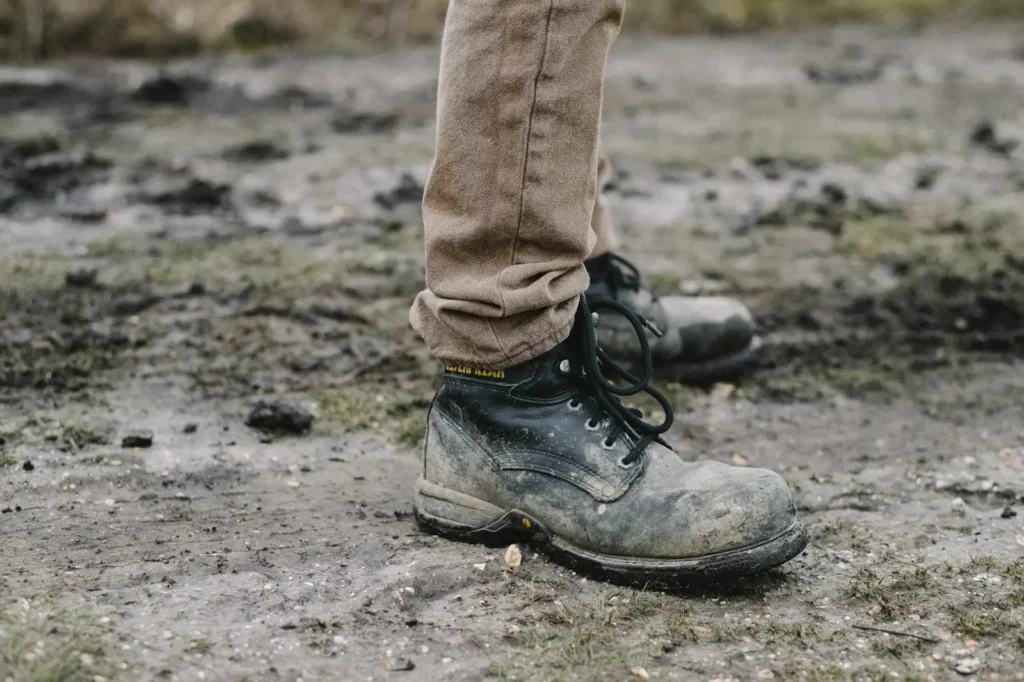
Leather remains the reference point among shoe upper materials for durability and shape retention, but grades sold under the same word can differ by a factor of three in abrasion life, and the difference comes down to how much of the grain layer survives finishing.
Hide is split into layers after tanning. The outer layer carries the tight fibre structure and the inner split is looser and weaker, so the grade is set by which layer is used and how heavily it is coated afterwards. Every step of finishing moves the material along two axes at once, gaining stain resistance and losing vapour transmission.
Full-Grain and Top-Grain
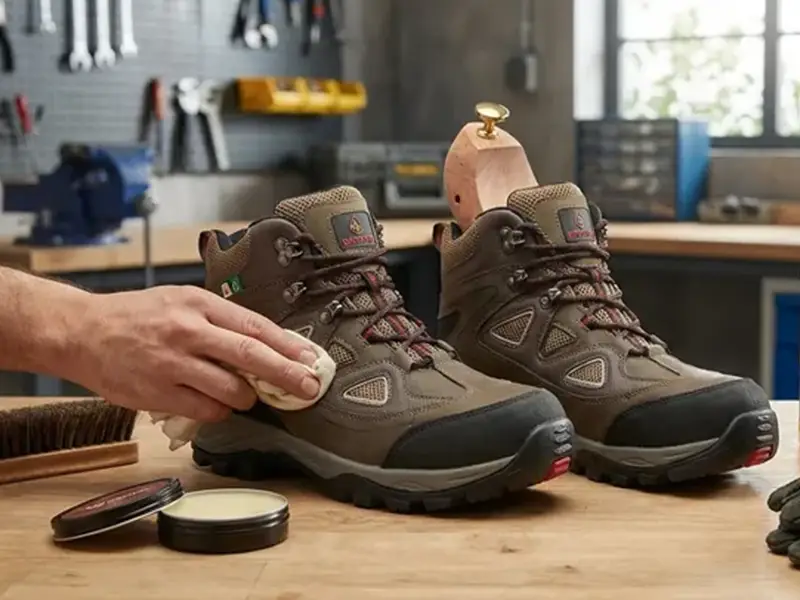
Full-grain keeps the intact grain surface, so fibre density at the surface is highest and the material tolerates scuffing without exposing a substrate underneath. Top-grain is lightly sanded and then coated; the finish improves colour consistency and stain resistance, but it lowers water vapour transmission, and a heavy finish can crack along flex lines before the hide itself fails. Both mould to the foot over weeks of wear, both need periodic conditioning, and both gain weight when soaked.
Nubuck, Suede and Split Leather
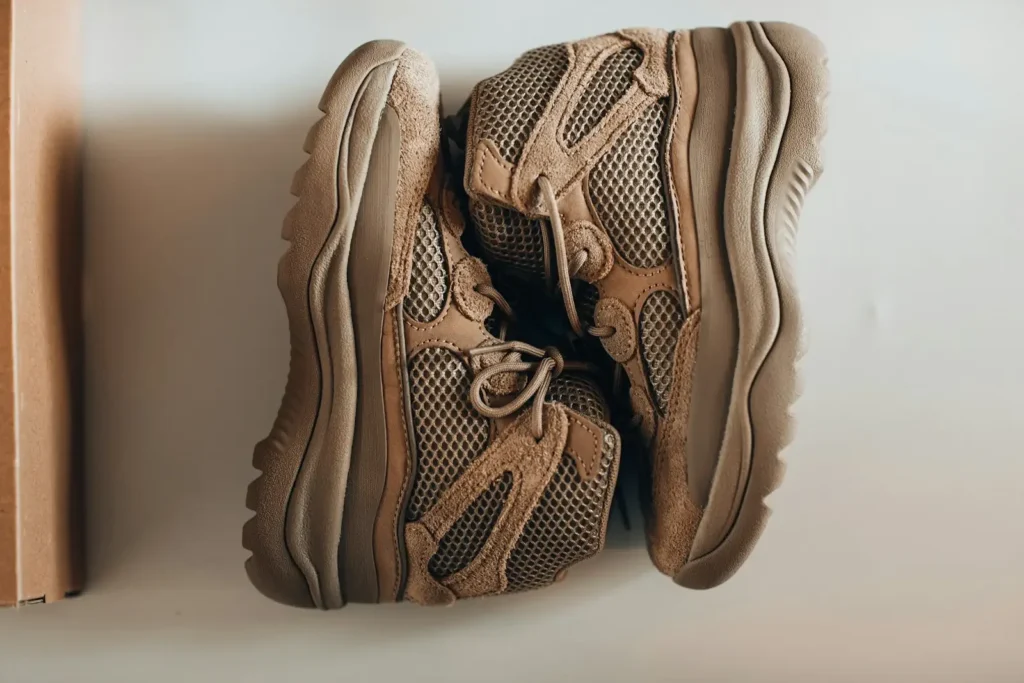
Nubuck is the grain side buffed to a fine nap, while suede is usually the inner split buffed, which leaves a looser and fuzzier surface. Both feel softer than coated leather and hide creasing better, and both absorb liquid until a repellent finish is applied. Split leather sits below nubuck in density: it is the cheapest route to a leather upper and the least tolerant of wet-dry cycling. In practice nubuck and suede suit lifestyle programs where hand feel sells the product, and split belongs in value tiers where the toe and heel are reinforced with a separate overlay.
Textile Uppers: Mesh, Knit, Canvas and Oxford
Textile uppers dominate athletic and casual footwear because they deliver the lowest weight per unit of breathability, and the differences inside the group come from how the yarn is assembled rather than from the fibre itself.
Polyester and nylon lead because they absorb almost no water and dry quickly, so the structure can be optimised for airflow instead of moisture handling. An open structure also pumps air as the foot flexes, so a loosely built panel can outperform a thinner but closed one.
Mesh and Engineered Mesh
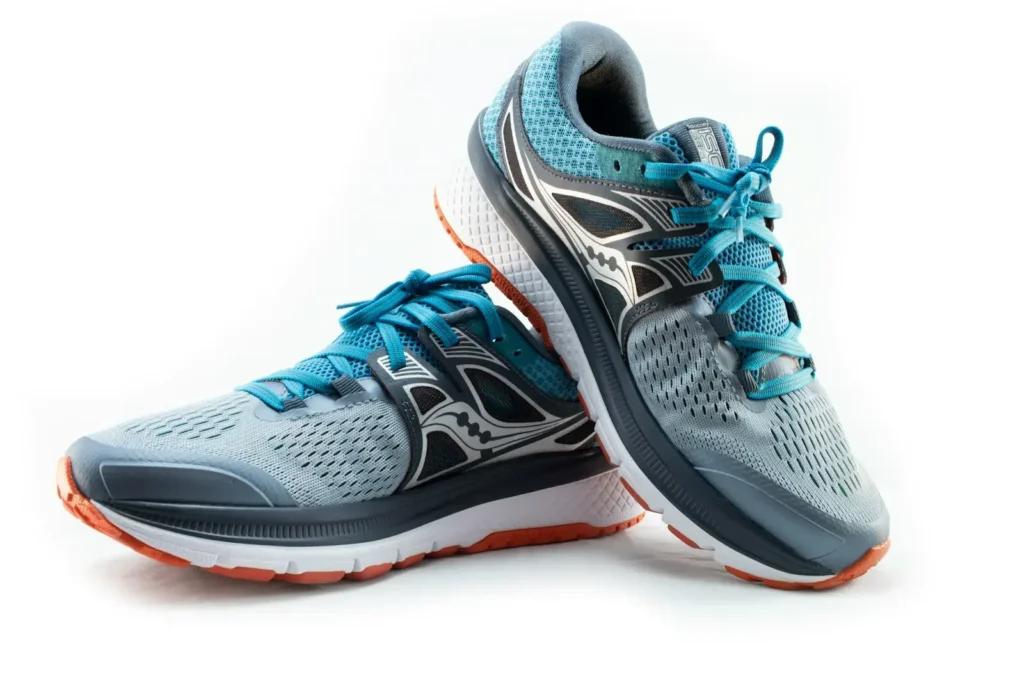
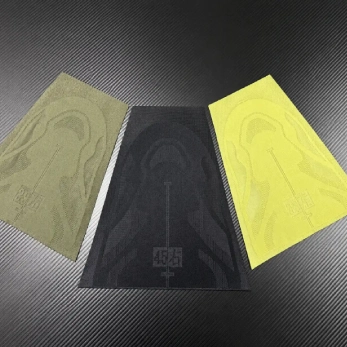
Mesh is a knitted or woven structure with deliberate openings. A single-layer mesh is light and inexpensive, but it tears at the eyestay and the flex point, so most commercial versions are engineered: hole size and density vary across the panel, closing at the collar and opening over the instep. The benefit is measurable rather than theoretical: in a controlled trial of 40 adults, a mesh upper held dorsal skin temperature rise to 1.6 C and plantar humidity to 8.4 percent, against 13.2 percent for a coated leather upper. Where a mesh program also needs weather protection, a three-layer mesh fabric bonds the face mesh to a membrane and a tricot backer, so the shoe gains water resistance without a separate bootie.
Knit Uppers
Knit builds the panel from interlooped yarn, often in one piece, which removes cut-and-sew operations and the seams that rub over the forefoot. The trade is support: knit stretches, so a knit program needs fused overlays or a denser zone at the midfoot, and recovery after repeated wear depends on yarn quality rather than on the construction name. Thin, low-grade yarn is where most complaints about hot and odorous feet originate, because the panel collapses and stops holding its shape.
Canvas and Oxford
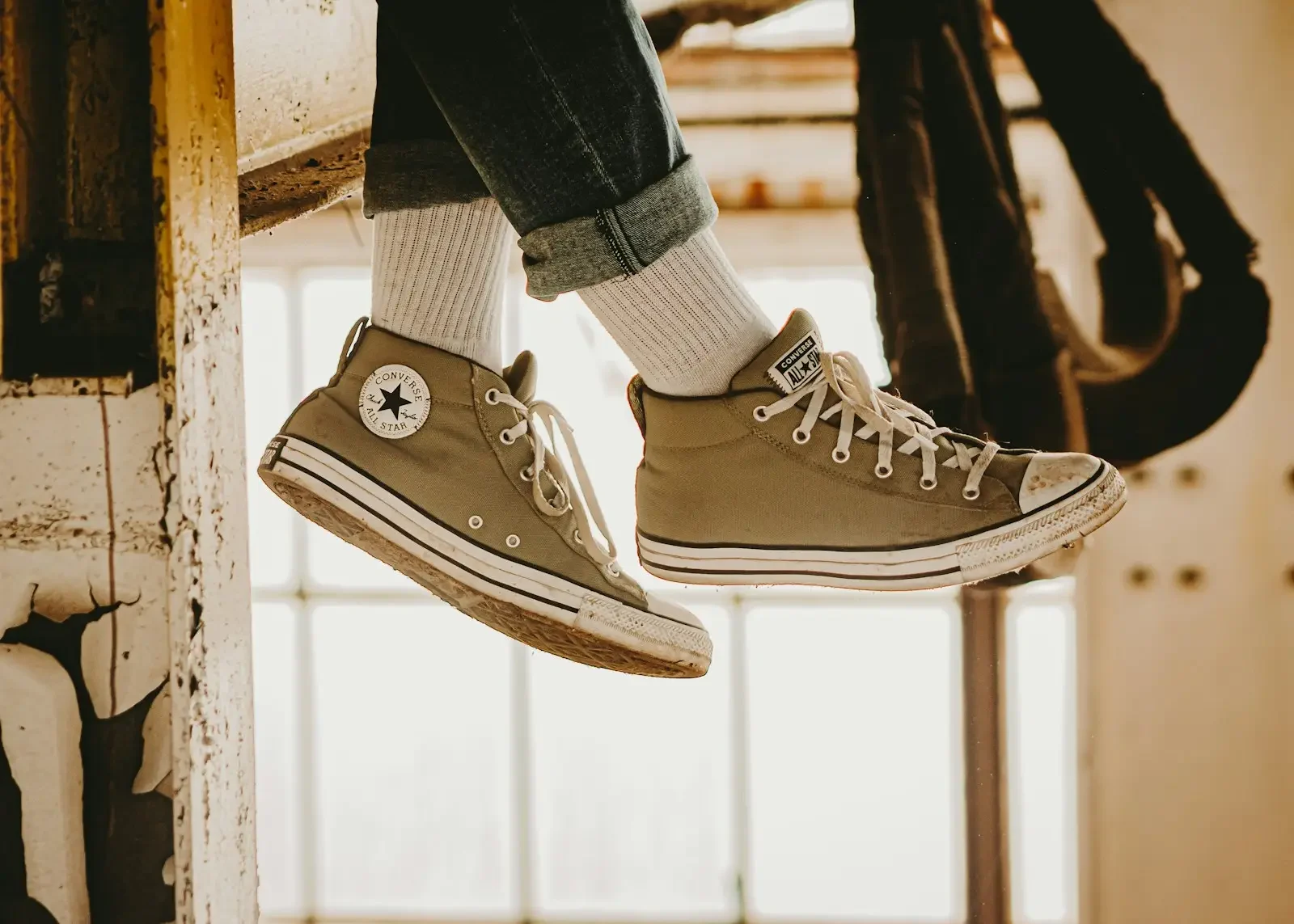
Canvas is a plain-weave cotton or cotton-blend fabric, and oxford is a plain or basket weave with a denser sett, usually polyester or nylon and frequently coated on the back. Canvas takes dye well and prints cleanly, which suits value casual lines, but it absorbs water and holds it against the foot. Coated oxford shrugs off light rain and wipes clean, which is why it dominates school, uniform and entry-level outdoor programs.
Synthetic, Coated and Laminated Uppers
Synthetic uppers solve consistency and cost, because a coated fabric or microfiber sheet delivers the same hand, thickness and colour across every roll, which leather cannot promise, and a laminated upper adds waterproofing without a separate membrane sock.
Coated fabric is a woven or knit substrate with a polymer layer on the face, while microfiber leather is a nonwoven microfiber base impregnated with polyurethane and finished to imitate grain. Both are traded by weight and thickness, and both are exposed to the same two failure routes: adhesion loss between coating and substrate, and hydrolysis of the polyurethane under warm humid storage. A synthetic that looks correct on the sampling table can still fail six months into a container journey.
How a Three-Layer Waterproof Upper Is Built
A waterproof breathable upper is normally a laminate of face fabric, membrane and a light backer, bonded with dot or powder adhesive so the membrane keeps most of its surface free to transmit vapour. The membrane blocks liquid water, the face takes abrasion, and the backer shields the membrane from the last. Membrane chemistry sets the character of the product: polyurethane films are economical and flex well, thermoplastic polyurethane resists hydrolysis better in hot climates, and expanded PTFE gives the highest vapour transmission per unit of water resistance at the highest cost. Bond strength is where programs fail, not vapour transmission. A waterproof fabric upper that passes a hand-pull test at the factory can still delaminate after repeated washing or a humid voyage, so the specification should carry peel strength and hydrolysis figures rather than the word waterproof.
How the Main Upper Materials Compare
Across shoe upper materials, breathability and water resistance move in opposite directions, abrasion resistance tracks density and coating weight, and cost tracks both plus the number of process steps required to finish the panel.
The ratings assume comparable quality within each family. A heavy canvas outlasts a thin knit, and a well-made coated fabric can beat a poorly finished split leather, so shortlist with the table rather than rank with it.
| Material | Breathability | Abrasion | Water resistance | Typical use |
| Full-grain leather | Medium | Very high | Medium when treated | Boots, premium casual |
| Nubuck and suede | Medium | Medium | Low to medium | Lifestyle, seasonal casual |
| Coated split leather | Low to medium | Medium | Medium to high | Value casual, school |
| Microfiber | Low to medium | High | Medium to high | Sports, uniform, vegan lines |
| Mesh, single or engineered | High | Medium | Low | Running, training, summer |
| Knit | High | Medium | Low | Lifestyle, walking, gym |
| Canvas | Medium to high | Medium | Low | Value sneakers, print programs |
| Coated oxford | Low to medium | High | High | Uniform, light outdoor, bags |
| Three-layer laminate | Medium | Medium to high | Very high | Hiking, all-weather commute |
Programs where ventilation decides the sale are usually specified against measured vapour transmission instead of material names, and the comparison of breathable materials for shoes covers the test methods in more depth.
How to Choose an Upper Material for a Program
Start from the use case and the target landed cost, shortlist two families, then verify the candidate against four measured properties on the specification sheet. Hand feel and colour come last, because both can be engineered inside any family.
Material is usually the largest single line in a footwear bill of materials, so a change of upper family moves unit cost more than a change of factory.
| Use case | First choice | Acceptable alternative | Usually avoid |
| Road running and gym | Engineered mesh | Technical knit | Coated split leather |
| Hiking and trail | Three-layer laminate with leather overlays | Coated oxford | Single-layer mesh |
| Uniform, school and work | Coated oxford or microfiber | Coated split leather | Canvas, untreated suede |
| Casual lifestyle | Full-grain or nubuck | Canvas, knit | Thin single-layer mesh |
Match Material to Use and Price Band
Running and training programs buy weight and airflow, so mesh and knit carry the volume and the reinforcement sits at the eyestay and toe. Hiking moves the requirement to water resistance and abrasion, which pushes the specification toward a laminate with a leather or coated oxford overlay. Uniform and work programs want a surface that wipes clean, prints a logo and holds colour across reorders, which favours coated oxford and microfiber. Lifestyle is the only segment where nubuck and full-grain earn their premium, paid for how the material ages rather than for a measured property.
Read the Spec Sheet, Not the Label
Labels disclose family, not grade. US labelling rules require upper, lining and sole materials to be stated by generic category, so textile and synthetic tell a buyer nothing about density or coating weight. Work and safety footwear is the segment where thresholds are published: EN ISO 20345:2022 sets an upper tear strength of at least 120 N, water vapour permeability of at least 0.8 mg/(cm2 h) with a coefficient of at least 15 mg/cm2, and no visible cracking of polyurethane uppers before 150,000 flex cycles. Outside protective footwear the same four measurements still predict returns: tear strength, vapour transmission, flex endurance and peel strength.
Common Failure Modes and How to Prevent Them
Defects in shoe upper materials cluster into four returns patterns: delamination of a bonded panel, hydrolysis of a polyurethane coating, abrasion breakthrough at the toe or heel, and water ingress at seams and needle holes rather than through the material itself.
Each pattern has a different root cause, and three of the four are decided before bulk production starts.
| Failure | Root cause | Countermeasure |
| Delamination | Weak adhesive bond, humid storage | Specify peel strength, test after wash cycles |
| Hydrolysis | Polyurethane ageing in heat and humidity | Request hydrolysis data, control warehouse climate |
| Abrasion breakthrough | Thin face fabric at high-wear zones | Reinforce toe and heel, raise coating weight |
| Seam leakage | Needle holes and untaped seams | Taped or sealed seams, seam sealing tape |
Lining choice belongs to the same decision, because a lining that abrades before the upper does more damage to perceived quality than a scuff on the outside. Pairing a coated upper with shoe lining materials that match its moisture handling protects the interior.
FAQ
Three questions come up repeatedly once a shortlist has been agreed, and none of them is settled by the material name alone.
Can shoe uppers be recycled?
Only partly, and the obstacle is construction rather than fibre. A single-material knit or canvas upper can re-enter a mechanical recycling stream, while a bonded laminate cannot be separated economically, so most laminate offcuts go to energy recovery. Fewer adhesive layers and separable components are the practical lever available today.
Is a heavier upper always more durable?
No. Weight correlates with density and coating weight inside one family, but not across families. A 300 g laminated mesh can outlast a heavier low-grade coated fabric because abrasion resistance depends on surface hardness and adhesion, not on mass. Judge durability from tear and flex data at the specified thickness.
How much does upgrading the upper add to unit cost?
It depends on how many steps the upgrade adds, not on the material name. Moving from single-layer mesh to a bonded laminate adds membrane, adhesive and lamination labour, which is a larger increment than moving from coated oxford to microfiber at the same weight. Ask for a cost breakdown by operation before comparing two quotes.